Feeds:
Posts

Over the next 20 years, Americans will demolish one third of our existing building stock (over 82 billion square feet) in order to replace seemingly inefficient buildings with energy efficient “green” structures.  Is demolition in the name of sustainability really the best use of natural, social, and economic resources?  Or, like the urban renewal programs of the 1960’s, is this well-intentioned planning with devastating environmental and
cultural consequences?

On Thursday, October 13th “The Greenest Building,” a new hour-long documentary by Eugene Oregon film producer Jane Turville, will be screened at The Fine Arts Theatre, 36   Biltmore Ave., Asheville.  The film presents a compelling overview of the important role building reuse plays in creating sustainable communities.  Narrated by David Ogden Stiers, “The Greenest Building” explores the myth that a “green building” is a new building and demonstrates how renovation and adaptive reuse of existing structures fully achieves the sustainability movement’s
“triple bottom line” – economic, social, and ecological balance.  Thefilm r eveals:  (a) how reuse and reinvestment in the existing built
environment leads to stronger local economies that can compete on a global scale, (b) that sense of place and collective memory, while intangible, are critical components of strong sustainable communities, and (c) the direct correlation between reuse of existing buildings and a significant reduction in greenhouse gas emissions, degradation of the natural environment and overuse of precious natural resources.

If you are interested in buildings, community development, sustainable communities or just plain want to find out if existing buildings really are worth keeping, plan to attend this special event. “The Greenest Building” starts at 7:00 pm and is free and open to the public.

SPECIAL THANKS TO OUR SPONSORS:


Beth Semadeni, David Battle, Ben & Cate Scales and Kieth Hargrove


The Preservation Society of Asheville and Buncombe County proudly announces a new partnership with the National Trust for Historic Preservation.  As the Local Partner of the National Trust, PSABC can work more effectively to protect the important historic resources
that make Asheville and Buncombe County such a unique place.

More than 120 of the top nonprofit preservation organizations in the country have chosen to become Statewide and Local Partners of the National Trust for Historic Preservation. The Statewide and Local Partners network provides nonprofits a forum for sharing preservation
practices, solving organizational problems, and improving their effectiveness.  Statewide and Local Partners have access to special National Trust benefits and resources. Affiliated organizations place high value on the opportunity to learn from each other and gain credibility in their direct association with a large national organization like the National Trust.

For PSABC, the partnership provides access to additional grant opportunities, information about model practices in preservation and property stewardship, advocacy, preservation education, and outreach.  “I know”, said National Trust President Stephanie Meeks, “the Preservation Society of Asheville and Buncombe County will add much to this group by bringing knowledge, expertise and experience to the growing network.”

“In our past 35 years as this community’s private historic preservation nonprofit, we have continued to grow in capacity and effectiveness in the protection of our historic built environment,” said PSABC Executive Director Jack W. L. Thomson.  “This partnership is the next natural step in our growth.  This affiliation with the Trust provides national exposure for our work and for Asheville as a special historic destination.”

The Preservation Society is celebrating its 35th anniversary in protecting the historic places that our important to our community.

MISSION:  Through preserving and promoting the unique historic resources of our region, the Preservation Society of Asheville and Buncombe County works to sustain the heritage and sense of place that is Asheville and Buncombe County.

####

Sunday, September 11, 2 – 4 p.m.

97 Haywood Street, Asheville

John Ochsendorf, of the MIT School of Architecture, describes the Basilica of Saint Lawrence as Guastavino’s “crowning achievement in the American building arts.”  The tour includes the basement of the building, with vaulting similar to Guastavino’s famous work at the Boston Public Library.  PS board member John Toms, Saint Lawrence archivist, will describe recently-located documentation of Guastavino’s design of the building.  The discussion will include Guastavino’s supervision of construction, Spanish design precedents, preservation challenges, and the building’s designation as Nationally Significant in the National Register.  The tour will continue briefly outside, and from there into the main church, where Guastavino used tile construction in every horizontal component of the structure.  The ground floor level of a tower stair, with catenary vaulting supporting treads and landings, will also be accessible for viewing.   The program begins at 2:00.  The basement hall will be open at 1:45 for viewing the vaulting, a small display, and for refreshments.    Enter by the side door on the Flint Street side, across from the Civic Center.  There is parking behind the church, in the gated lot across the street from the church, or in the first lot next door to the church.

Sunday, August 28, 2011, 2 to 4 PM
Historic Sherrill’s Inn
Highway 74A, Fairview, NC

Sherrill's Inn, c. 1801, site of 2011 PSABC Annual Picnic

Our annual picnic event is a potluck, so break out your best recipes to contribute to the spread.  We welcome your sweet & savory, your hot &  cold.  Our generous hosts at Sherrill’s Inn, John & Annie Ager, will be providing tours & historical details about this spectacular setting.  PSABC staff & Board will provide updates on our current projects. 

This large weather-boarded house was operated as an inn that served travelers passing through Hickory Nut Gap during the 19th century.  Bedford Sherrill began operating the inn in 1834. It is a two-story saddlebag-plan structure that probably dates back to around 1801. Also located
on the property is a very old smokehouse and tradition maintains that this building served as a frontier “fort” in the 1790s. More than likely this small rectangular building is the area’s oldest structure. 

Directions: From Asheville take I-240 east to exit 9 (Bat Cave, Lake Lure and Highway 74A east). Take Highway 74A east through Fairview to the very end of the valley. As you climb up the winding road to Hickory Nut Gap, look for the State Historic Sign and Sherrill’s Inn on your right up on a hill. This will trip will take you 20 minutes from downtown Asheville.

At Tuesday’s City Council meeting, the Decorative Finishes and Restoration Program at AB Tech was honored with a mayoral proclamation (text below).

WHEREAS, the Decorative Restoration
program at A-B Technical Community College
was founded in 1988 as a cooperative venture with the Biltmore Estate. Students
have come from as far away as Alaska and Vermont to take advantage of the only
full-time program of its kind in the country, which graduated its final class
this year; and

WHEREAS, the program has graduated
nearly 300 students, all skilled artisans, a number of whom have begun thriving
restoration businesses all across the country and have worked on the
restoration of historic artifacts and buildings, churches and cathedrals; and

WHEREAS, two passionate and
visionary teachers have guided the Decorative Restoration program during its 23
years: Derick Tickle, a master craftsman who previously taught for London’s
distinguished City & Guilds, arrived from England in 1989 and directed the
program until his retirement in 2005 when Tim Hanlon, a 1997 graduate of the
program, took over its leadership; and

WHEREAS, we have these two
instructors and their students to thank for the beautifully restored ceiling of
the County Courthouse, which took six years to complete, and for the uniquely
decorative foyer and Council Chamber of City Hall; and

WHEREAS,
we appreciate the program’s philosophy that the greenest building is the one
already built. The Decorative Restoration program has helped keep Asheville’s heritage
intact for today and tomorrow. Through its contributions, Asheville’s citizens learn to appreciate our
historic buildings, their decoration and construction, and to preserve them for
future generations.

NOW, THEREFORE, I, Terry Bellamy, Mayor of the City of Asheville,
do hereby recognize the


Decorative Restoration
Program


at
A-B Technical
College as an exemplary program, which
has made a significant contribution in the preservation of historic buildings
inAsheville.


IN WITNESS WHEREOF, I have hereunto
set my hand and caused the Seal of the City of Asheville, North Carolina, to be
affixed this 28th day of June, 2011.


___________________________

TERRY M. BELLAMY

MAYOR

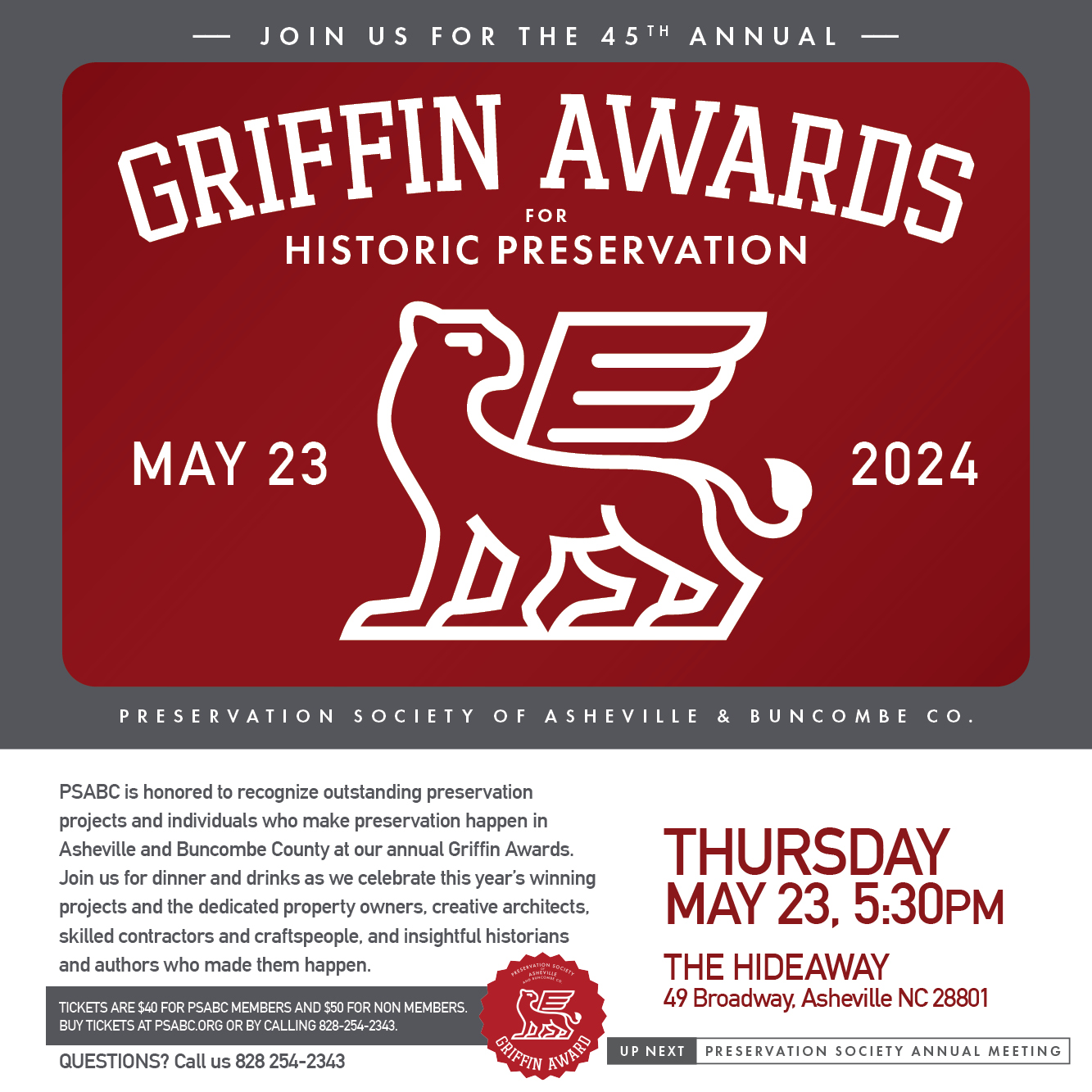
Griffin Awards

Each year, PSABC presents the Griffin Awards for Historic Preservation.  Projects from Buncombe County that have been completeled within the last 24 months, or thos that are deemed 90% complete may apply in one of the following award categories.

    1. Restoration- Projects that accurately depict
      the form, features, and character of a property as it appeared at a
      particular period of time.
      Restoration may entail removal of features from other periods of
      the building’s history and reconstruction of missing features from the
      restoration period.  It may include
      limited and sensitive upgrading of mechanical, electrical, and plumbing
      systems and other code-required work to make the property functional
    2. Rehab – Projects that allow for newer
      compatible use of a historic building through repair, alteration, and/or
      additions while preserving portions or features of the building which
      convey its historical, cultural, or architectural values.  Changes that achieve a false sense of
      historical development over time will not be considered.
    3. Adaptive Re-use – Projects that adapt a historic
      building for a purpose other than what was originally intended while
      preserving portions or features of the building which convey its
      historical, cultural, or architectural values
    4. Research
      & Publication
      Preservation Education Award  Recognizing excellence in communicating the value of historic
      preservation to the public including: exemplary historical research,
      publication, oral history initiative, and the development
      of innovative education program or website.

PLEASE NOTE:  There is not a category for renovations, remodeling or new construction not specifically within a historic district or traditional neighborhood.

New Website

Here is our new website; it is a work in progress and we welcome suggestions you may have to make it better.

Follow

Get every new post delivered to your Inbox.