by Dale Wayne Slusser – November 2026
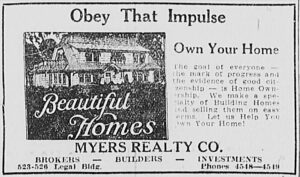
We value our historic housing stock in Asheville, but don’t often think about how it came to be or what factors, like time and economic conditions, contributed to their building. Those of us in Asheville and Buncombe County who experienced the 2007-2008 housing crash which resulted in the “the Great Recession”, witnessed firsthand how speculation and overextending one’s “financing” in the building of houses can be risky and sometimes catastrophic! If only those builders (and those financing the building) had researched the history of speculation building in Asheville, especially during the “roaring” 1920’s, they may have been more cautious? Recently, while researching a house in Kenilworth for a friend, I was reminded that we should be learning from history, not only from the good but from the bad as well. The house at 11 Pickwick Road and its neighbor at 13 Pickwick Road, both which became orphaned shortly after their construction in 1925, gives us a small lesson on the potential woes of speculation building. Com C. Myers, the builder of both houses was a grocery store owner who decided in 1920 to jump into the real estate fray. With little capital, most of which he borrowed from a family member, Myers began in earnest buying, selling, and subdividing lots, and building houses. Although he had some initial success, the toll which it took on his family, his finances, and even on his very life, in the end, proved to be tragic and catastrophic. Myers’ story should be for us, a cautionary tale!
The post-World War 1 prosperity of the 1920’s created a massive building boom in Asheville and Buncombe County, where building lots and houses, we’re being built, bought, and sold like commodities on the stock exchange. In 1923, the City of Asheville boasted that it had issued building permits, for that year, to represent an investment of over $4,500,000,[1] which in today’s equivalent would represent over $88 million! And that number did not consider the building activity in the surrounding Buncombe County.
This building frenzy of the 1920’s not only attracted many out-of-town professional architects and builders, but it also attracted men from non-related professions, to jump into the fray and try their hand as “Real Estate Men”. Then being a “real estate man” meant more than just buying and selling property, and more often also included real estate development and property management. Com C. Myers, a young entrepreneur from Wilkes County, North Carolina, having no experience in building or real estate, by 1924 had joined Asheville’s ranks as an official “Real Estate Man”.
Commodore Columbus Myers was born on March 16, 1889, to grocer William C. Myers and his wife Martha, in Jennings, NC. In 1908, at the age of nineteen, Com (aka Commie) Myers came to Asheville to attend the Asheville Business College. The Asheville Business College, operated by Principal Henry S. Schockley, offered courses in the following: “book-keeping, business practice, office spelling, correct English, business arithmetic, commercial usages, plain penmanship, rapid calculation, letter writing”.[2] After college, Myers got a job as a traveling salesman with his territory being Virginia, Tennessee, and Western North Carolina.[3] The 1910 US Census records that Myers was living back home in Wilkes County, NC, working as a “Newsboy” in the “novelties” industry? [4] But soon thereafter, Myers made Asheville his permanent residence.
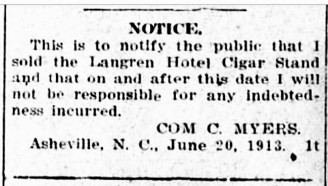
In 1913, Com Myers purchased the Cigar Stand at the Langren Hotel in downtown Asheville, from its former proprietor. Sometime soon after, within the year, Myers decided to re-sell the business to F. B. Ingle. Apparently, Ingle did not have the cash to purchase the business, so instead he traded a lot he had in West Asheville, along with some yard goods that could be resold. However. A few months later, Com Myers sued F. B. Ingle for $2,000, claiming that Ingle had mis-represented the size and value of the parcel, and the quantity and quality of yard goods, that he traded for. Myers claimed that Ingle had said the lot had 70 feet of frontage on Haywood Road, but that in fact it was only 35 feet wide. [5] Myers also claimed that instead of the 1,800 yards of yard goods that Ingle claimed he was giving him, turned out to be only 900 yards, and that they were “old and shop worn”. [6] Ingle had been in the dry goods business until his store burned down in 1902, [7] after which in 1904 he sold the remaining business and went into the real estate business. One wonders if the yards goods were leftovers from the fire? Anyhow, Myers lost the case when the court claimed it as a “non-suit”. [8] Perhaps because Myers had already sold the property to another buyer in May of 1914? [9]
Also in 1914, 23-year-old Com Myers married 19-year-old Ina Mae Brown, the daughter of Asheville businessman, Virgil F. Brown and his wife Dora. Neither Com nor Ina appear in the Asheville City Directories until 1917, so it’s unclear where they were living from 1914-1917. However, the Buncombe County Register of Deeds recorded the birth of a daughter, Mary Alice in 1915, and a son, William in 1916, so they obviously were living in the area (Buncombe County).
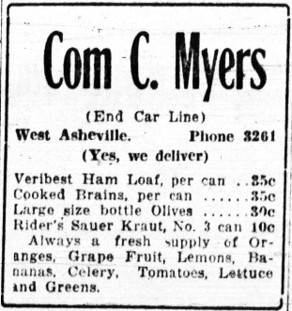
In 1917, Com C. Myers opened a grocery store business on Haywood Road in West Asheville. He owned and operated the business for two years, before selling it in June of 1919 to his nephew, J. Roy Reid of Statesville, NC. [10] It was at this time, 1919, that Myers appears to have started his career in real estate. I say “appears” because in both the 1920 and 1921 city directories, only his address is given, no employment, and even the 1920 U. S. Census listed his occupation as “None”. [11] The only indication of his activity comes from January of 1920, when he purchases a lot in West Asheville, ironically, from F. B. Ingle! [12] Myers built a small bungalow on the lot, which upon completion in April of 1920, he sold to Fred & Irene Brown [13] for $1,500. [14] This house, which sat at 24 Hyde Street (now addressed as 32 Yale Street), is no longer standing and has been replaced with a modern house.
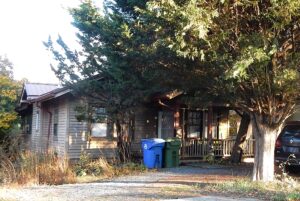
66 Brevard Road
After the selling of the house on Hyde Street, in the Spring of 1920, Myers purchased two large lots (100 ft. frontage each) on the eastern side of Brevard Road, about a half block south of Haywood Road in West Asheville Although they were two large lots, they had been combined years earlier to form one homesite, with the house being on lot 37. [15] Myers quickly resold the house and lot 37 , but then subdivided the vacant lot 38 into two fifty-foot-wide lots. Myers built a small bungalow on the northern half of the lot (then addressed as 60, later 66 Brevard Road) and moved into it temporarily. [16] In January 1921, Myers advertised that he was willing to “exchange two large lots, located in best residential section of West Asheville, also some cash” for any house or lot in the city and the suburbs or even in Hendersonville. In the advertisement, Myers gave his address as “60 Brevard Road”. [17] The following month Myers accepted an offer of trade from Mrs. Fay Haddon and Luella F. Dunn. [18] The ladies traded a lot on Woodrow Avenue [19] for the house and lot 38 on Brevard Road.
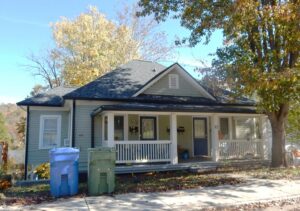
83 Washington Road
A few months after selling the house on Brevard Road, in May of 1921, Myers purchased a house and lot at 39 Central Avenue in downtown Asheville. [20] I believe that the Myers family may have moved into the small house, but not for long. On July 14, 1921, just a few months after buying the house, they sold the house at 39 Central to C. L. & Jennie Williams for $2,950. [21] The following day, Ina Myers ran the following advertisement in the Wanted section of the Asheville Citizen-Times: “SMALL or large house with sleeping porch, where it is cool and shady. If at pre-war price, apply or address I. M. 39 Central.” [22] Either someone replied to Ina’s advertisement, or Com Myers was quickly able to find another house, as a month later, in August of 1921, the Myers purchased an existing house at 83 Washington Road. [23] Com and Ina Myers lived in the house at 83 Washington Road only one year, before selling it in September of 1922 to John H. & Ida Cathey. [24] Actually I think Myers did a deal with Cathey by trading properties with him.
The same day that Myers sold Cathey the house at 83 Washington Road, Cathey transferred one of his properties at 38 Swannanoa Avenue in West Asheville to Com Myers. [25] In the 1923 Asheville City Directory, Myers and his family were listed as living at 38 Swannanoa Avenue.
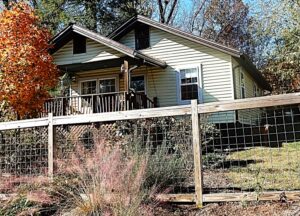
39 Wellington Street
Ever the developer, Myers divided the long lot at 38 Swannanoa Avenue into two lots, with the house at 38 Swannanoa Avenue on the western half, and making a buildable lot on the eastern half which bordered Wellington Street. A month after purchasing the property, Myers obtained a building permit to build a “4-room residence” estimated to cost $1,500, on Wellington Street. [26] Upon completion, the small bungalow that Myers built was then addressed as 39 Wellington Street.
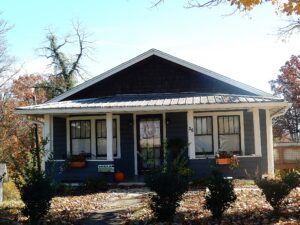
26 Mimosa Avenue
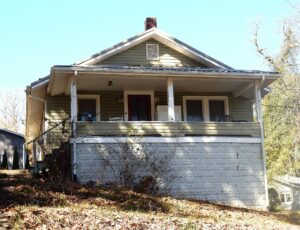
371 Sulphur Springs Road
As Myers was finishing up the house at 39 Wellington Street, in December of 1922, he purchased his next two properties, first a lot on Sulphur Springs Road, [27] and second, a lot on Blue Ridge Avenue. [28] Both properties were in West Asheville. The lot on Sulphur Springs Road, also fronted on Haywood Road. Myers immediately split the lot into two, with the northern half fronting on Haywood Road, and the southern half facing on Sulphur Springs Road. Two months later, Myers obtained two permits on the same day, to build a “4-room residence” on Sulphur Springs Road to cost $2,000, as well as a “5-room residence” on “Haywood Road, near Sulphur Springs entrance” to cost $3,000. [29] The houses, respectively now addressed as: 371 Sulphur Springs Road and 26 Mimosa Avenue (originally 1334 Haywood Road), were built as one-story bungalows.
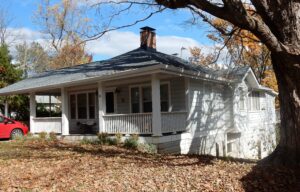
41 Blue Ridge Avenue
The second property that Myers purchased in December of 1922, was a lot on the east side of Blue Ridge Avenue in West Asheville. [30] Just a few weeks after purchasing the lot, Myers obtained a building permit to build a $3,000 house and a $300 garage on the lot. [31] Shortly after the house was completed, Myers and his family moved into the house (originally addressed as 23 Blue Ridge Avenue-now 41 Blue Ridge Avenue) and used it as his base while ratcheting up his development projects.
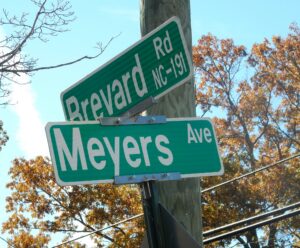
Myers Avenue Sign
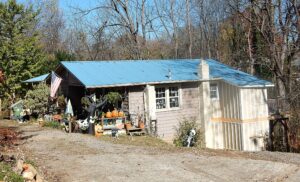
5 Meyers Avenue
In May of 1923, Com C. Myers purchased two lots behind the house at 162 Brevard Road in West Asheville. [32] The lots were accessed via an alley on the south side of 162 Brevard Road that ran east from Brevard Road. The alley was subsequently named “Myers Avenue”, although it is now mistakenly named “Meyers Avenue”. Myers’ two lots were at the end of the alley. He subdivided the two lots into four lots [33] and built identical houses on each lot. The 1925 Asheville Sanborn Fire Insurance map numbered the houses as “A, B, C, & D”. [34] By 1930, the houses were addressed as 1 Myers Avenue, 2 Myers Avenue, 3 Myers Avenue, and 4 Myers Avenue. Only the house at 2 Myers Avenue survives today, addressed as “5 Meyers Avenue”. “Meyers” Avenue is a mis-spelling of Myers Avenue.
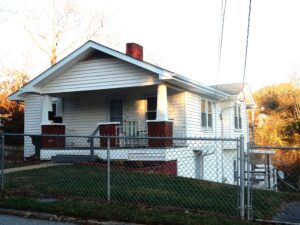
170 Swannanoa Avenue
It was reported on April 1, 1923, that C. C. Myers had obtained a building permit to build a $1,500 residence at “170 Swannanoa Drive”. [35] Although he did pull a permit to build the house, it was not at “170 Swannanoa Drive”, rather it was at 166 Swannanoa Avenue in West Asheville. The lot upon which he built the house was then owned by his nephew J. R. Reid, who had purchased the vacant lot a month earlier. [36] Like most of his houses, Myers financed the building of the house, with his nephew assuming the mortgage following its completion. [37] This small bungalow still exists and is addressed as 160 Swannanoa Avenue.
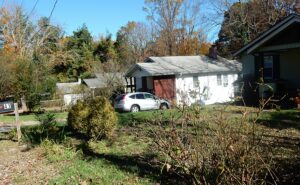
41, 45, & 53 Balsam Avenue
It was also in April of 1923 that Myers began his first advertising of his multiple properties for sale, specifically four houses that he had recently completed on Haywood Road, Sulphur Springs Road, Blue Ridge Avenue, and one unaddressed house (which from its description was most likely the house at 39 Wellington Street). [38] While still trying to sell these houses, in September of 1923, Myers purchased a large lot on Balsam Avenue, just off the northside of Haywood Road in West Asheville. [39] For those history enthusiasts, I note that Myers bought the property on Balsam Avenue from Rutherford P. Hayes, the third son of our 19th President. Hayes and his family had moved to West Asheville (from Chicago, IL) in 1900, purchasing 95 acres on the north side of Haywood Road. [40] Hayes not only developed his own West Asheville lands, but also joined with African-American developer, Edward W. Pearson to develop two subdivisions (Park View and Pearson Park) in West Asheville for African-American homebuyers. The parcel of land which Myers purchased from Hayes, had a 200-foot frontage on the east side of Balsam Avenue. Myers subdivided the parcel into four 50-foot-wide lots and built a one-story bungalow on each lot. The houses were subsequently numbered 41, 45, 49, and 53 Balsam Avenue. By the Fall of 1924, all four houses had been completed and sold.
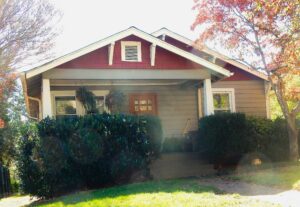
62 Craggy Avenue
Com Myers continued his real estate development into 1924. On February 4, 1924, Myers purchased a lot on Craggy Avenue in Falconhurst Park in West Asheville from Edwin Bowles. [41] Three days later he obtained a permit to build a “5-room” residence on the lot, estimated to cost $4,500. [42] I presume that the $4,500 was a mis-print, as that was almost double the price for the type of one-story bungalows that Myers was building. In fact, after it was completed, the house was sold with the buyer assuming a $2,700 mortgage, [43] which was a more realistic price. The house still stands at 62 Craggy Avenue.
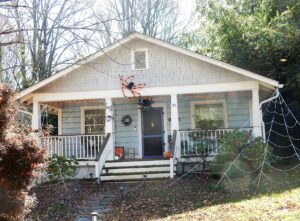
10 Tarpon Avenue
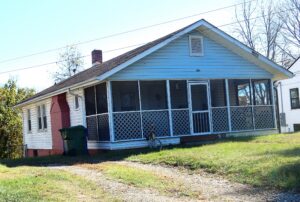
226 Virginia Avenue
As Myers was starting the construction of the house on Craggy Avenue, near the end of February 1924, he purchased a lot on nearby Virginia Avenue. [44] On February 23, 1924, just a few days after purchasing the lot on Virginia, Myers obtained two building permits, one to build a 5-room residence (to cost $3,500) on Virginia Avenue, and one to build another 5-room residence (to cost $3,000) on Tarpon Avenue [45] (on a lot that he had purchased from Rutherford P. Hayes the week before). [46] Both houses still exist, the first at 226 Virginia Avenue, and the second at 10 Tarpon Avenue, in West Asheville.
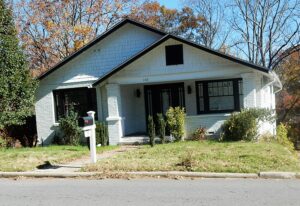
100 Brevard Road
Just a few days after obtaining the building permits for the houses on Virginia Avenue and Tarpon Avenue, Myers purchased another lot for development. On February 27, 1924, Myers purchased a large lot (Lot 42) on the east side of Brevard Road in West Asheville, [47] on the same side of Brevard Road as his two earlier Brevard Road developments. Myers split the 100-foot-wide lot into two 50-foot-wide lots. In April of 1924, Myers obtained a permit to build a “7-room residence” on the northern half of the lot, estimated to cost $4,500. [48] Myers built an attractive brick three-bedroom bungalow on the half lot, which upon completion was addressed as 100 Brevard Road. Com & Ina Myers, moved into the house immediately after its completion, and made it their family home (instead of a speculative house). Com Myers would live the remainder of his short life in this home (spoiler alert)! Myers sold the southern half of the lot in July of 1924 to builders O. V. Himes, G. C. Terhune, and B. J. Johnson [49] who subsequently built a brick bungalow on the lot that was addressed as 104 Brevard Road. Both houses, 100 and 104 Brevard Road are still standing.
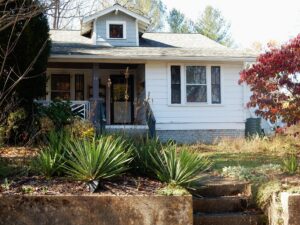
34 Oakwood Street
On April 30, 1924, Myers purchased a lot on Oakwood Street, in West Asheville. [50] A few days later he obtained a building permit to construct a “6-room residence” (to cost $3,800) on the lot. [51] On this project, we get a glimpse into Myers’ tricky financing- first he got a loan of $534 to purchase the lot, [52] then he borrowed $3,000 from Wachovia Bank to build the house, then he borrowed $3,000 from the Metropolitan Insurance Company to pay back the Wachovia loan, [53] and then when he completed to house, he sold it with the buyer assuming the $3,000 mortgage from Metropolitan Insurance Company. [54] This house still survives at 34 Oakwood Street, just north of Haywood Road in West Asheville.
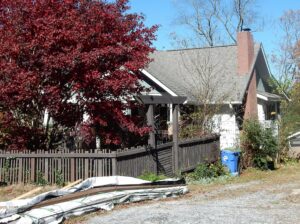
127 Brucemont Circle
In October 1924 Com Myers purchased another lot in West Asheville from W. E. Edmonds. [55] Actually I suspect it was more of a trade, as the same day Myers also accepted an offer from W. E. Edmonds to purchase one of the houses (53 Balsam Avenue) that Myers had built on Balsam Avenue in 1923. [56] The lot that Myers purchased from Edmonds was on Buttrick Avenue (now Brucemont Circle). Myers obtained a permit in February of 1925 to build a “5-room residence” (for $3,500) on the Edmonds’ lot. Myers built a one-story bungalow with a large gabled front porch, that when finished was addressed as 127 Brucemont Circle. This house still stands in its original location.
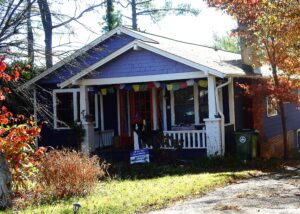
7 Ramoth Road
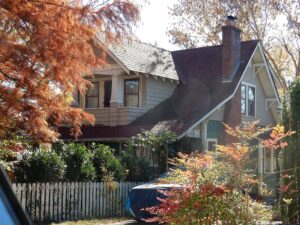
11 Ramoth Road
In November of 1924, Com Myers purchased two lots on Carolina Avenue (now Ramoth Road) in Norwood Park in North Asheville. [57] On the first lot, Myers built a one-story bungalow, similar to the ones he had been building in West Asheville. When completed the house was addressed as 1 Carolina Avenue (now 7 Ramoth Road). On the second lot, which was adjacent to the first lot, Myers built a two-story bungalow. When completed, that house was addressed as 3 Carolina Avenue (now 11 Ramoth Road). Myers also built a garage for each house, with both garages being accessed via a shared driveway between the two properties. Both houses that Myers built in Norwood Park were slow to sell. The two-story bungalow that he built at 3 Carolina Avenue, finally sold in September of 1925, with the buyer assuming TWO previous mortgages that Myers had borrowed against the house, one for $4,500 and a second for $2,040! [58] Myers had advertised the house in June of 1925 for $9,500, [59] so if Myers got his asking price, he still made a profit of almost $3,000. Unfortunately, the one-story bungalow built at 1 Carolina Avenue did not sell until after Myers’ death, at a foreclosure sale.
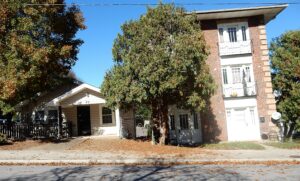
20 & 26 Annandale Avenue
In February 1925, Com C. Myers purchased a lot at the northwest corner of Annandale Avenue and Henrietta Street for $6,000. [60] The high price for a lot was because it had an existing house (20 Annandale Avenue) on its west side. I’m sure what attracted Myers was that because the house was built on one side of the lot, leaving a large vacant area at the corner, that the lot could be subdivided into two lots. And that’s what he did, no doubt anticipating building a house on the vacant lot. However, he could not sell off the existing house and its half of the lot until November of 1925, [61] and then the following month he accepted an offer for the vacant corner lot. [62] Three years after selling the corner lot, a developer erected a three-story nine-unit apartment house on the site (26 Annandale Avenue).
1925 was the year that Myers decided to go big. On April 27, 1925 the following announcement appeared in the Asheville Citizen-Times:
MYERS REALTY COMPANYHAS opened offices, 521 Legal Building, associated with Mr. Com C. Myers, a builder of wide experience, having the reputation of having built and sold to satisfied home-seekers numerous houses, has now under construction four bungalows which will be ready for the market in about 60 days. [63]
The announcement also informed the public that Myers Realty Company included associates, “H. L. Timmons, a former merchant of Asheville,” and “Mr. G. E. Elmore, former owner of the West Asheville Real Estate Co., Haywood Road, West Asheville”.
In March of 1925, Myers purchased another lot on Brevard Road, which was adjacent to the Lot 42 that he had purchased in 1924. [64] The lot was just south of the house built at 104 Brevard Road, and was only the northern half of Lot 43. Myers did not build on this lot, instead he sold it in December of 1925 to B. J. Johnson. [65] Johnson in turn sold the lot to C. W. Chaney [66] who subsequently built a house on the lot (106 Brevard Road).
In April 1925 Com Myers purchased two lots on Kenilworth Road, just north of the Kenilworth Inn. [67] This was Myers first foray into development outside of West Asheville or North Asheville. The two lots were on the south side of what was then a part of Kenilworth Road but later separated and named Pickwick Road. Myers assumed a deed of trust for $3,100, which the grantor had taken out in 1924 to purchase the two lots. In September of 1925, Myers obtained two loans to build a house on each lot. On September 1st, Myers borrowed $4,500 against Lot 10, [68] and on the September 15th, he got another loan for $5,500 against Lot 11. [69] Both loans came from Trustees, David B. Harris and Tristam Hyde, representatives of The State & City Bank & Trust Company of Richmond, Virginia. These out-of-town investors had first been called upon in 1922 by the builders of the George Vanderbilt Hotel, and since Asheville’s building boom was so hot, The State & City Bank & Trust Company of Richmond began offering its loan and mortgage services to Asheville investors.
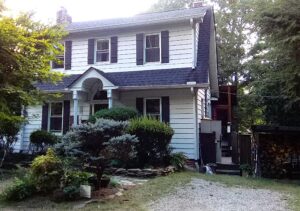
11 Pickwick Road
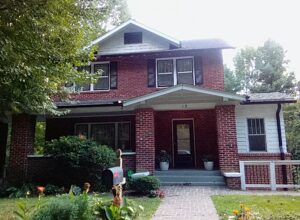
13 Pickwick Road
On Lot 10 in Kenilworth, Myers constructed a two-story “six-room” framed Dutch Colonial, gambrel-roofed house, which is now addressed as 11 Pickwick Road. On Lot 11, Myers constructed a two-story “seven room” brick bungalow, which is now addressed as 13 Pickwick Road. Both houses were first advertised for sale in June of 1925, with 11 Pickwick selling for $9,500, and 13 Pickwick for $11,500. [70] Oddly, the following month their prices were raised to $11,500 and $15,790 respectively. [71] Then by September and October the prices settled, with 11 Pickwick priced at $12,500 and 13 Pickwick at 14,500. [72]
The brick bungalow at 13 Pickwick Road sold soon after it was completed. [73] Though not a criticism, the sale of this house is a good example of Com Myers’ wheeling and dealing. Assuming from the previous ads, the house was for sale for $14,500. Henry & Bessie Noland purchased the house with a $4,000 loan from Com Myers (akin to but not quite owner financing), but along with the purchase they also assumed two mortgages that Myers had previously taken out to build the house, the first mortgage for $5,500 (which Myers had gotten from the State & City Bank & Trust Company of Richmond), as well as a second mortgage for $2,500. [74] This means that the Nolands bought the house for $12,000 in mortgages. We don’t know if they put any additional cash down at the initial purchase, but they apparently traded another property as their downpayment. [75] This other property was a property that they had also previously purchased (March of 1925) from Com Myers on Linden Street. I don’t think the Nolands ever moved into the house at 13 Pickwick, nonetheless, by August 1926 they had defaulted on the mortgage to Myers. [76]
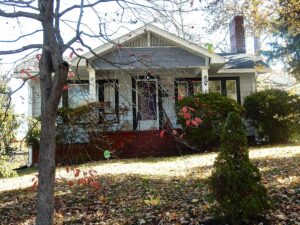
187 Dorchester Avenue
Myers purchased a lot in April of 1925 on Dorchester Avenue in West Asheville. [77] A few weeks later he borrowed $4,500 against the lot to construct a house on it. [78] In November of 1926, Myers sold the completed house, first addressed as 183 Dorchester, but later changed it to 187 Dorchester Avenue, to fellow realtor Eugene T. Ducker. [79] Ducker used the house as his residence and real estate office until selling it in 1928.
In June of 1925 Myers purchased three lots along the eastern of Sand Hill Road in West Asheville. [80] Myers never built any houses on the lots. They eventually became the site of the Elkins Gospel Chapel (later the Sand Hill Missionary Baptist Church) at 232 Brevard Road. The three lots have been further subdivided and are now the sites of ten new houses (200, 212, 218, 222, 226, 230, 236, 238, 240, & 242 Brevard Road).
“HALF MILLION DOLLARS IS RECORD OF MYERS REALTY”, announced the September 19, 1925 edition of the Asheville Citizen-Times. [81] The article reported that Myers Realty’s prime function was to “foster and promote home ownership”, and that they achieved this by making “a specialty of building homes and selling them on a most easy payment plan”. Mr. Myers told the reporter that not only had the firm had a “a phenomenal record of business” over the last year, “totaling well over half a million dollars” but that he was “optimistic in his anticipations of the future in the local realty field”. [82]
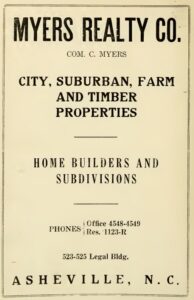
As 1926 dawned, Myers Realty continued its buying and selling of properties and had grown to have “eight experienced salesmen”. [83] In fact, they even paid for a full-page advertisement in the 1926 Asheville City Directory. [84] However, despite Myers’ optimism for the future of “the local realty field”, 1926 proved to be a tragic year. 1926 was the year that the bubble burst on Asheville’s real estate frenzy, with house prices dropping by fifty-percent! According to the records of the Buncombe County Register of Deeds, Myers only had two recorded real estate transactions in 1926. But even more devastatingly tragic than the 1926 real estate crash was the sudden death of Myers. Com C. Myers died at his home at 100 Brevard Road on May 17, 1926 at the age of 36, [85] leaving a wife and two young children. The death certificate says the cause of death was myocarditis (inflammation of the heart), with a contributory condition of “acute alcoholism”! Sadly, despite in his Will leaving his wife the four houses he owned, they were all mortgaged to the hilt. In 1928, Ina Myers had to buy back the family home (100 Brevard) at a courthouse foreclosure sale. [86] Eventually, Ina Myers moved the family to Knoxville, TN in the early 1930’s and went into the retail business with her brother Fred Brown. She passed away in 1959, over thirty years after her husband’s early death.
Com C. Myers’ story ended tragically for his family, yet he did have a modicum of success, and in fact a large percentage of the houses that he built have survived for almost a century and now contribute to Asheville’s historic housing stock.
Photo & Image Credits:
Note: All photos not enumerated below are by the author.
“OBEY THAT IMPULSE”-Myers Realty Ad-Asheville Citizen-Times, December 5, 1925, p. 9.
Cigar Stand Notice-Asheville Times, June 20, 1913, p. 6.
Com C. Myers Grocer Ad- Asheville Times, May 9, 1919, p. 9.
Myers Realty 1926 Ad in City Directory- Asheville, North Carolina City Directory [1926], Ernest H. Miller, Editor (Asheville, NC: Piedmont Directory Co., 1926), ad is between pages 512-513. https://lib.digitalnc.org/record/24884?ln=en&v=pdf