By Dale Wayne Slusser -September 2026
“There stands our old homestead, doomed and abandoned, scarred, and worn by decades of time, it stands as a
symbol of endurance and love, of hardships and hopes of our pioneer ancestors.” – Helen Gash Pearce, 1961
The area around modern-day Exit 55 off of I-40, at the bend of the Swannanoa River, was once known as Azalea, North Carolina, and was not only the site of the first “house” built west of the Blue Ridge Mountains in Western North Carolina, but was also the site of several later historic houses of the nineteenth and early twentieth century, built by “Old Buncombe” family names such as: Gash, Gudger, Porter, and Stevens, as well as newcomers, Lewis and Riddick.  Most of the houses of Azalea are no longer standing due to the construction of I-40 and the Blue Ridge Parkway, which intersect at the center of the forgotten town of Azalea, NC.  At the center of Azalea, North Carolina was the progenitor, Gash Farm, homestead of the Gash family since 1800.
It was at Azalea, that Samuel Davidson built the first “house” west of the Blue Ridge Mountains, in what would become Buncombe County.  In 1784, Samuel Davidson, along with his wife and infant daughter, and a Black enslaved woman, came up the Blue Ridge Escarpment from Old Fort (aka: Davidson’s Fort) to settle on his 440-acre land grant in the newly opened lands of Western North Carolina, shortly after the American Revolution.  The oft-told story is that Samuel and his family settled on his claimed land, but that shortly thereafter, Davidon was lured to the top of Jones Mountain by a band of Cherokee hunters and subsequently killed and scalped.  Upon hearing the shot from their cabin, Samuel’s wife, Mary along with their “infant” daughter Ruth (who was about 15 years old), and a Black enslaved woman, fled the scene, eventually making their way back down the mountain to Davidson’s Fort.
I would be amiss not to mention that we now know from oral tradition, that the enslaved woman was named Liza (Eliza), and that she eventually returned to Buncombe County, most likely as early as just a year or two after her harrowing flight, when Samuel Davidson’s brother William and sister Rachel and their families came to settle in what would become known as the “Swannanoa Settlement”.  Eliza was still enslaved to the Davidson family when she returned to Buncombe County, but eventually her daughter, also named Eliza, was able to purchase her own freedom and marry a freedman named John Henry, and establish a homestead in Chunns Cove.  Eliza’s descendants still live in Asheville and Buncombe County to this day.[1]

This closeup from Price and Strother’s “First Actual Survey of the State of North Carolina” (published in 1808) shows the old stage road (which in 1783 was just a rough trail) which was the probable route that Samuel Davidson took from Crooked Creek, Burke County (shown on right above) up the Blue Ridge Escarpment through the mountain gap (see arrow above) to settle on his claimed land in 1784. “Moriston” is Morristown, the original name of Asheville. Although the town name had been changed to Asheville by the time the map was published, when Price and Strother were doing their actual surveying in the 1790’s, it was still called Morristown. I suspect that the square labeled “Davis” was the “Swannanoa Settlement” where Samuel Davidson’s brother, Major William Davidson made the first successful settlement, following his brother’s slaying.

Being a stickler for facts, over legend, I was overjoyed recently to discover a “primary source”, contemporary with the events, which substantiates the oft-told story of Samuel Davidson.  Although the source doesn’t substantiate all the minute details of the story, such as the length of his stay, which seem to vary in different accounts, it does show not only the exact location of Davidson’s land, but that indeed Samuel Davidson did “settle” on his claimed lands long enough to have started a homestead.  But first, let us take a brief look at who was Samuel Davidson?
Samuel Davidson and his twin brother William, were born to John and Margaret Davidson on October 10, 1736 in Legacorry, Shankill Parish, County of Armagh, Northern Ireland.  Shortly thereafter, John Davidson and his family immigrated to America, settling first in Philadelphia and then by 1740 on to Augusta County, Virginia.  Samuel married Mary Smith (the sister of another famed early Buncombe County settler Daniel Smith) in 1855.  By the late 1770’s Samuel Davidson and his family, and his brothers John, William and George Davidson and their families had, moved into the frontier of Western North Carolina to what today is called Old Fort in McDowell County.  In 1780 Samuel was issued a land grant for 400 acres of land at “Boyer’s Fork on Crooked Creek”, which was situated just north of Old Fort in neighboring McDowell County, bordering the Burke County line.[2]   While a resident of McDowell/Burke County, during the Revolutionary War, Samuel Davidson served as a Captain in the 2nd Rowan County Regiment (1776-1777) and then the Burke County Regiment (1777-1781).[3]
I believe that it was shortly after the war, c. 1783 that Samuel received his land grant for 440 acres, “on both sides of the Swannanoa River” in what is now Buncombe County.  His grant was most likely never recorded but the original deed was held onto by Samuel’s widow, or his brothers, which explains why in 1792, Samuel’s brother John Davidson and their uncle Ephraim Davidson were able to apply for and receive a land grant for the exact location of Samuel’s original claim.  In fact, the description on the survey and the deed of John & Ephraim Davidson’s grant says, “Including the Improvements made by Samuel Davidson…”.[4]   I doubt that Ephraim Davidson ever occupied the site, but I suspect that John Davidson may have occupied it for a few years, before he and his uncle sold the property to Martin Gash in September of 1800.[5]
In the 1800 U. S. Census, John Davidson is listed as a resident of Buncombe County, while his uncle Ephraim Davidson was still listed as a resident of Iredell County, NC.   John Davidson subsequently moved his family to Maury County, TN.
Martin Alley Gash’s original name was Martin Alley.  The story of Martin’s arrival in America in 1749, and his subsequent acquisition of his new surname has been chronicled by a historian descendant, Sylvia Jackson, in her tome, Gash Genealogy:
The ship Martin Alley boarded was the Crown; its course was Rotterdam, Netherlands to Cowes, England, and finally to the Port of Philadelphia.  The ship’s captain was Michael James.  The ship arrived at Philadelphia in August 1749. It carried five hundred passengers, most of whom were German or Swiss.  During the long voyage, Martin Alley developed a strong friendship with another passenger, Hans Jacob Gass, a German.  Martin was called Gash’s Alley by the passengers. At the end of the voyage, passengers were required to identify themselves to the court for the record of their arrival in America.  Martin Alley was too sick to appear in court, but his good friend Hans Jacob Gass was there.  Herr Gass called out the name Martin Gash for his sick friend, and the clerk recorded his name as such on August 30, 1749.  From that time forward, our ancestor was known as Martin Alley Gash.[6]
Shortly after his marriage to Ann (Dennis) Johnson, of Burlington, NJ, in December 1766, Martin Gash moved to the western frontier of Augusta County, Virginia.  It was in Virginia that the Gashes’ three sons, Joseph Dennis, John, and Martin Alley Gash Jr., were born and raised.  All three sons were young men when they moved to Buncombe County with their parents in 1792, and within a few years each had married a Buncombe County gal and purchased their own lands.  Son, Joseph Dennis Gash married “Demy” Woodfin in 1793, son John Gash married Nancy Gudger (daughter of William & Patsy Gudger who had moved from Virginia to Buncombe County at the same time that the Gashes had moved here) in 1795, and then around 1796, Martin Gash’s youngest son, Martin Alley Gash, Jr. married Mary Gudger (the sister of his sister-in-law)![7]
Assuming that the Martin Gash who bought the Davidson tract in 1800 was Martin Gash I, he was then elderly and near his death.  It could have been Martin Gash’s son, Martin Gash II, as both father and son show on the 1800 U. S. Census living in Buncombe County.  If it was Martin Gash I , the original immigrant, which I suspect it was, at the time he purchased the Davidson tract, he was living on the original lands which he had purchased in 1792, on “both sides of McDowells Creek” (now Gashes Creek) on the southside of the Swannanoa River, about a mile west of the Davidson grant.[8]   No record of Martin Gash’s death survives, but as he appears to disappear from the records after 1800, we can conclude that he died shortly thereafter.  Another evidence that this was the original Martin Gash who purchased the Davidson tract in his old age, is that there is no record of Martin Gash selling the property, and yet it later ends up in the hands of his two sons John and Martin Gash II, which we can assume that they acquired the property through inheritance.  Although no deed of conveyance to John and Martin II appears in the record, there are references in later deeds to a “conditional line” dividing the tract between John and Martin Gash II, with John retaining the western half and Martin Gash II retaining the eastern half.  Just a note to show the reason for the confusion in the deeds- by 1820 Martin Gash II was calling himself Martin Gash, Sr. and his son was being called Martin Gash, Jr. (though he was actually Martin Gash III).
It is unclear when the actual Gash house was constructed.  From a 1933 article and an early photograph we know that the house was constructed as a one-and-a-half story log cabin.  Supposedly it was built “with portholes equipped for fighting Indians”[9] , however these “portholes” that were discovered during a 1933 rebuild, were most likely evidences of an original loft floor which may had been removed to raise the first-floor ceiling at some point.  The one-story cabin with a loft was a common house-type during the early days of Buncombe County.  The 1933 article suggests that the log cabin was built in 1794, however Martin Gash did not buy the property until 1800, which I suspect would be a more accurate date for the cabin, unless the original cabin was built by John Davidson when he and his uncle owned the property from 1792-1800, which I doubt was the case?

This closeup of a mid-1850’s Railroad map is the earliest map that I have found which depicts what would become Azalea, NC. The area shown on this map is the site of Samuel Davidson’s settlement-the probable site of his cabin is shown here by a star. John and Ephraim Davidson’s 440-acre land grant, which included both sides of the bend of the Swannanoa River, by the time of this map, had been divided in half with the Gash family owning the western half, and the Gudger family, owning the eastern half . The Gash and Gudger houses are marked and labeled on this map. Also note that where the stage road crosses the Swannanoa River, is what is now appropriately called “Gudger’s Bridge”. Current-day Exit 55 of I-40 intersects with US 70, about halfway between the river and the Gudger house.

As mentioned earlier, in 1817, just prior to relocating his family to Missouri, Martin Gash II sold his half of  the Gash (old Davidson grant) on the east, to his brother-in-law Joseph Young Gudger.  The earliest map that I have found which shows the locations of the Gudger house and the Gash house is a WNCRR railroad survey from about 1852-1854.  The map shows the Gash house on the west side of the Swannanoa River and the Gudger house on the east side of the river.  The proposed railroad, shown on the map, was not built until three decades later, being finally completed in 1880.
John Gash and his family were most likely the first to occupy the Gash house for any length of time.  It was there that John and Nancy Gash raised nine children!  John sold the property, which included only half of the Martin Gash land, but with some additional adjacent lands that John had accumulated, to his son Burdie (Burdett) Stuart Gash in 1843, retaining a life estate for him and his wife to occupy the house until their deaths.  Nancy Gash died in 1851, and John Gash died in 1857.  Both John and Nancy died at the house and are buried in the Newton Academy Cemetery off Biltmore Avenue.
Burdett “Burdie” Gash was born to John and Nancy Gash in 1810 at the Gash House.  Burdie Gash had married Elizabeth Weaver (of Weaverville, NC) in 1843.  By the time of his father’s death (1857), Burdie, and his wife and their six children were living in the Gash house, with his aged parents.  Shortly thereafter, their youngest son John Stuart Gash was born.  Burdett was a farmer by trade, being widely known for his huge watermelons, which became a family tradition at the Gash Farm, being grown by subsequent generations.  In 1854, B. S. Gash made fast friends with the Asheville News staff when he delivered to their offices a huge watermelon, “which weighed twenty-nine and a half pounds and measured three feet in circumference”.[10]

Burdie Gash

Elizabeth Gash

One cannot tell this story without mentioning the enslaved people who served on the Gash farm over the years.  Sadly, most of their names are unknown to us.  According to the U. S. Census of 1850, Burdie Gash had one enslaved female, a 12-year-old.  Also in 1850, his son John Gash had six enslaved people, two females, and four males.  After John’s death, his executor advertised that four enslaved people were for sale from the estate.  The only names that I could find was a female named Charlotte who was given to John Gash by his father in-law William Gudger in 1832,[11]  and a man named “Guinea Bob”, who was formerly enslaved by Martin Gash, but lived to be reportedly 115 years old, and was known for his many stories of the “old days” on the Gash Farm.[12]

This photo, taken years after Emancipation, shows the two-pen log cabin which housed the enslaved workers on the Gash farm.

One author recalls that Burdett & Elizabeth’s children were all “educated in a private school”, which was most likely the Newton Academy, which was on S. Main Street (Biltmore Avenue) in nearby Asheville.  By 1880, only son John and one of the twins, Ellen, remained at home.  Burdett’s oldest son, Lucius had died in the Civil War in 1864, the others had married and left the nest to make their own families.  Elizabeth Weaver Gash died in 1888, and her husband Burdie Gash died a few years later in January 1891.[13]
Upon his death in 1891, Burdie Gash willed the house and part of the farm surrounding it to his thirty-year-old son John Staurt Gash, but through his son-in-law, William R. Alexander acting as trustee.  The remainder of his property was to be divided among the other sons and daughters.  John Staurt Gash who was then unmarried, was described as “never a well strong man, but gentle and lovable, patient and kind to all.”[14]  Mostly likely John had some type of cognitive or physical disability; however, he must have been capable of running a farm, or his father would not have willed it to him.


John Stuart Gash

It was around this time, 1891, that John’s brother, William Leander Gash returned to the family homestead from Texas.  A surviving family photo shows three loaded covered wagons and is said to have been taken as the Gash family were leaving Texas and heading back east.  W. L. Gash was born to Burdie and Elizabeth Gash in 1852 at the Gash farm.  At the age of 21, William went to New York and enrolled as a cadet at West Point Military Academy in 1873.  He was only there a year-family lore says that he was expelled for disrespecting an upper classman.   Nonetheless, he left West Point in 1874 and decided to move “out West” to Texas, where in 1877 he met and married Susan Taylor of Brownsville, TX.  The couple’s first six children, Burdette, Lucius (died in infancy), Fred, Calvin, George (died in infancy) and Helen were born in Texas.
I suspect that W. L. Gash and his family moved back to help run the family farm alongside his brother John.  In 1897, just a few years after William’s return, his brother John died at the young age of 36.  Because John never married and thus had no heirs, the farm was inherited by his siblings.  This necessitated John’s executor, his bother-in-law, W. R. Alexander to petition the Probate Court to appoint commissioners to appropriately determine an equitable division of the land.[15]  The commissioners divided the property amongst the four groups of heirs.  The portions were not equal in square footage, but all four were valued at $2,000 each.  W. L. and Susan Gash were apportioned “Lot No. 1”, consisting of 84-1/2 acres on the east end, bordered by the Swannanoa River on the south.  Most importantly, their lot included the house, and so they officially became the next owners of the Gash house and remaining “Swannanoa Farm” (the official name of Gash Farm).

In March of 1897, following the death of John Stuart Gash, Court-appointed commissioners divided the Gash property amongst the surviving heirs of Burdie Gash. W. L. Gash was allotted Lot #1, which included the old Gash house.

W. L. Gash returned to Asheville in 1891 along with his wife and their four surviving children, Burdette, Fred, Calvin, and Helen.  Not long after their arrival, son Wilbur Leroy was born in 1892, the first of their children to be born on the old Gash Farm at Azalea.  In the ensuing few years, on a two-year cycle, W. L. and Susan Gash would produce three more children, Charles (1894), Mary (1896) and Rachel (1898).  A family photo, c. 1905 shows William and Susan and their eight children in the front yard of the original Gash log cabin (which by then had been clad in clapboard siding).  Two men in hats also show in the photo, who most likely were farmhands, as the one is proudly standing behind a table on which sits two large watermelons.  The melons were no doubt grown from the original plants that had been planted in years past by W. L.’s father Burdie Gash, which were renown for producing record-breaking sized melons![16]
We can imagine that the ten-member Gash family soon outgrew the original small cabin, which is why it appears from family recollections, that at one point (most likely during W. L. Gash’s ownership) the cabin was enlarged with a one-story addition on its right side.  The new addition was comprised of three rooms, a dining room, kitchen and pantry.  The former “slave cabin” which sat in front of the new addition was repurposed as a “woodhouse” to store firewood.  Although we have no photo evidence of this addition, we know of its existence from a floor plan & sketch drawn by Rachel E. Gash around 1933 showing what the Gash house looked like when she was growing up (born in 1898).  The sketch shows the two-room cabin with its three-room addition.

W. L. Gash family in front of the Gash house, 1905. Back row (left to right): Calvin Gash, “farmhand”, Burdette Gash, “farmhand & watermelons”, Fred Gash. Front row (left to right): Helen Gash, Mrs. Susan Gash, Rachel Gash (in wagon), Leroy Gash, Mr. William Leander Gash, Charles Gash, and Mary Lou Gash (at W. L.’s knee).

Prior to 1896, the Gash Farm was accessed from the north off the old Stage Road (now US 70).  Before 1896, the Swannanoa Drive (now Swannanoa River Road) followed the river east from Asheville, as it does today, however prior to 1896, when the road got to the Asheville Pumping Station (now the intersection of E. Azalea Road) it turned north, and went up a steep grade, about where E. Hawthorne Road is now, through the woods to join the old Stage Road at what would later become Oteen, continuing on to Gudger’s bridge.  An 1896 reporter described the situation: “Near here [the pumping station]… the driver must turn north and make the trip to Gudger’s bridge over a succession of hills and hollows, over a road of heavy grade and rough way, and one to destroy the nerves of the most patient.”[17]  But in 1896, Swannanoa Drive was extended from the pumping station to more closely follow  the river southward and eastward to Gudger’s bridge.  This section of new road, which is now called E. Azalea Road, was described when it opened in 1896 as 2-1/2 miles long , and that “the very few grades are comparatively no grades at all.”[18]  This almost level road was especially appreciated by farmers and other material handlers with their loaded wagons.

This excerpt from a 1903 Map of Buncombe County (with labels by author) shows the new Swannanoa Drive (now called E. Azalea Road), which opened in1896, and its relationship to the Swannanoa river (double curvy line) and the old Stage Road (now US 70).

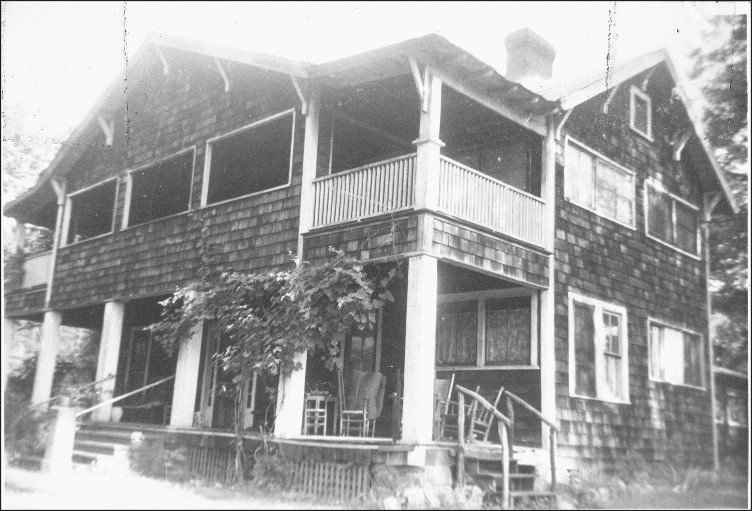
Sometime during W. L. Gash’s ownership (in the early 1900’s), he built a large two-story gambrel-roofed addition to the rear of the cabin.  The new addition was clad on the exterior with wood-shingle siding and included a covered side porch on the first floor.  A vintage photo, c. 1920s shows the gambel-roofed addition connected behind the original 1-1/2 story cabin.  I suspect the photo was around 1925-1930 as it shows the weather-boarding on the front cabin to be deteriorated and partially falling off, in stark contrast to the painted weather-boarding shown on the earlier 1905 photo.

This c. 1925-1930 photo shows the shingle-clad gambrel-roofed rear addition on the old Gash house. Notice the rockers and clothes-line on the side porch of the rear-addition.

Another large two-story gambrel-roofed structure was built, no doubt by W. L. Gash, directly behind the house.  A vintage family photo, taken from the rear of the house, labels the structure as a  “Cabin”.  One-story lean- porches were added on to the rear of the addition.  These porches appear to have functioned as carports to shelter the family’s wagons and farm equipment.  In the same photo, two structures appear in the left background.  To the far left is a small log structure with a stone base, which most likely was a springhouse (or possibly a smokehouse).   Another photo of the same “Cabin” structure, taken years later in the 1950’s, shows that later additions were made to the structure, including two-story sleeping porches.  This structure was used for many years to house boarding guests, during the farm’s tourist home era-but that’s getting ahead of our story!

The c.1905 photo (top), shows the gambrel-roofed “Cabin” and other outbuildings on the Gash farm, just north of the Gash house. The late-1950’s photo (below) shows that the one-story porches on the “Cabin” were later enclosed, and two-story sleeping porches were added as well, no doubt to house boarders. But by that time (1959) the “Cabin” was mostly being used as a barn and storage shed.

W. L. Gash soon turned the family farm, named “Swannanoa Farm” into a viable agricultural business, which included a vineyard and fruit orchard.  In 1898, Gash displayed some of his “Swannanoa Farm” apples at the Asheville Citizen newspaper offices, asking if any local “pomologists” could identify the species of the apples.[19]  Around 1903 Gash incorporated the farm under the name of “W. L. Gash & Sons”.  By then son Calvin was 21 years old and Fred was 20 years old, but the other “sons” were under 12 years old.  The farm did not have a staple crop, but it was diversified, growing grapes, pears, sweet potatoes, apples, and other variety of products.  In fact, at the 1912 Western North Carolina Fair, W. L. Gash & Sons won the prize “offered for the best and most artistically arranged horticultural exhibit, no less than ten varieties, product of exhibitor’s own farm.”[20]
In 1910, W. L. Gash patented a “reversable or sidehill plow,”[21] for use on steeply sloped fields, which Asheville had aplenty. A standard plow throws the furrows only in one direction, and so when used going back and forth on a steep hillside, half of the time it would throw the furrows uphill, which made those passes difficult.  But a “reversable or sidehill plow”, could be used in either direction, yet always throwing the furrows downhill.  In February of 1910, it was reported that “several of the plows are now being made at Weaverville and unless the patent right is sold the inventors will establish a factory in Asheville.”[22]   A model of the Gash sidehill plane, which was probably the prototype, still remains and is now exhibited at the Dry Ridge Historical Museum in Weaverville, NC.

The prototype model of W. L. Gash’s patented “Sidehill Plow” is displayed at the Dry Ridge Historical Museum in Weaverville, NC.

Speaking of Weaverville, in 1901, W. L. Gash hosted the first of many subsequent Weaver Family reunions held at “Swannanoa Farm” at Azalea (alternately known as Glen Inglis, NC).  The Weavers were all descendants of Jacob Weaver, the founder of Weaverville, NC.  Those descendants were known as “The Tribe of Jacob”.  W. L. Gash’s mother, Elizabeth Foster Weaver Gash, was the daughter of Rev. Jacob Weaver.  Although the Weaver reunions had been held since the early 1859,[23]  the 1901 Weaver reunion was not the first Weaver reunion held at the Gash Farm.  A 1935 report says that the reunion record books show that in January of 1861, the reunion was to held at “Swannanoa Farm”, but it was sparsely attended due to a 12 inch deep snow![24]   The 1901 reunion was a grand affair with many guests arriving the evening before and pitching tents to sleep in overnight.[25]  I have found that the Weaver family reunion, which was always alternating its location, was held at the Gash Farm in subsequent years- 1925, 1930, 1935, and in 1939 (this year a group photo was taken and printed in the newspaper).[26]   The Weaver Reunion continues to this day.
Henry Ford’s first Model A car came off the factory line in 1903.  Little did the Gash family know at the time that the mass production of the “automobile”, would soon change the course of their lives and the fate of the Gash Farm.  Throughout the first decade of the 1900’s and into the early part of the second decade (1910-1920), “Swannanoa Farm” was purely an agricultural business run by W. L. Gash and “Sons”, but as the First World War came upon the scene, life at the farm began to change.  By 1915, the “Sons” of W. L. Gash and Sons, Fred and Calvin were in their thirties and had already left the farm.  Calvin Gash had married in 1911 and moved with his bride to Texas and then later to Alabama.  Fred Gash had left the farm at 18 to seek his fame and fortune in Georgia and Florida, and although he had returned to Asheville by 1915, he was living on his own in downtown Asheville and working as a car mechanic at Sawyer Motor Company.  Also, by 1915, son Charles Stuart Gash was old enough to be working on the Gash Farm, and though he was working there in 1917 when the war broke out, he immediately enlisted and was sent overseas from 1917-1918.  Son Wilbur Leroy “Roy” Gash who was also working on the farm when war broke out, was drafted and inducted into the Army in 1918.
Although all the sons returned to live on the Gash farm by 1920, including Calvin with his wife and children, only Charles Gash returned to help W. L. Gash (then over sixty-five years old) work on the farm.  Fred and Wilbur had taken jobs as car mechanics in Asheville, and Calvin was working as a house carpenter.  These factors considered, it is not surprising that in the summer of 1920, the Gash family decided to get into what today is called the agricultural tourism business.  The National Agricultural Law Center describes the trend: “The agricultural tourism (agritourism) movement is a booming global trend that bridges farming and travel. It allows farmers to diversify income by inviting visitors onto working farms or ranches for educational and recreational activities, while meeting consumer demand for sustainable travel and local food.”[27]
“Swannanoa Farm” was uniquely situated to start its new summer agritourism business, as it sat adjacent to (on the north) the newly opened United States hospital for veterans suffering from lung-related diseases such as tuberculosis and poisonous-gas exposure.  Later known as Oteen Hospital, the hospital is still functioning as a veterans’ healthcare facility (Charles George VA Medical Center).  Although the Gash farm would not accept “sick” visitors, it would accept visiting family of the patients.  Even more advantageous to the new business, was the farm’s proximity to the “Azalea” train station, which was literally just down the hill from the farm.  This station was the official (the closest) station for visitors and staff headed for the hospital.
“Swannanoa Farm” first opened for business in July of 1920, under the management of W. L. Gash’s daughter, Helen.  One of the first advertisements for the farm appeared on July 9, 1920 in the local newspaper:
WANTED: boarders or campers, who enjoy country, at Swannanoa Farm, seven miles from Asheville. $9.50 per week Write. H. Gash, Azalea, N. C.[28]
The Gashes even advertised in other southern states, such as Florida and Alabama.  For over a century Asheville, with its mild climate, had been a draw for people fleeing the dreadful summer heat of those deep south states.  I have found an advertisement for “Swannanoa Farm” in a Montgomery, Alabama newspaper from June 22, 1920, which predated an of the local Asheville advertisements:
WANTED—Tourists to come to Swannanoa Farm, Near Asheville, N. C.  In the heart of the mountains. Excellent country fare. Board $9.50- $11.50 per week.  Furnished tents pitched for camping parties. Write, H. Gash, Azalea, N. C.[29]
It’s amazing to think that W. L. Gash would open his house to visitors in 1920, as the US Census of 1920 indicates that at the time, the Gash house was home to W. L. and Susanna Gash and their eight grown children (all in their 20’s or 30’s), plus a daughter-in-law and two grandchildren, for a total of twelve residents!  Perhaps it was a measure to produce income to support his expanding family?
One of the earliest guests at Gash Farm, starting the first week of July 1920, just after they opened for business, was “Mr. Manly Pearce, of Edenton”, of whom it was reported, “has been spending a short while as a guest at Swannanoa Farm.”[30]   Apparently it only took “a short while” for romance to blossom into love, for the next year, 1921, Kader Manly Pearce returned to Gash Farm to marry his summer landlady, Helen Taylor Gash.[31]  In fact, the young couple setup housekeeping at the farm, and together for many years, managed the farm’s agritourism business.
One of the benefits of staying at “Swannanoa Farm” (later called “Gash Farm”), was the “home-cooking” offered to its guests (boarders), which included fresh milk, farm-gown fresh vegetables and meats, and orchard-grown fruits, all grown on the farm.  In addition to providing meals for their boarders, occasionally the farm would open as a restaurant, as in June of 1921, when they advertised “special chicken dinners any time this week”, inviting persons to “drop a card” to them “stating time and number in your party.”[32]  The farm also offered its guests other amusements and recreational activities, such as wagon rides and square-dancing.
During the 1920’s and 1930’s, “Swannanoa Farm” continued to operate as a legitimate farm, as well as a tourist farm.  One of the farm’s cash products was hog raising and selling.  In March of 1922, they advertised for sale: “A nice bunch [of] purebred hogs, 7 or 8 months old, sired by “Swannanoa” Case’s big boar.”[33]  It seems from numerous advertisements over the years that they specialized in Duroc pigs.[34]
Along with the opening of the “Swannanoa Farm” tourist home, the early 1920’s was a time of love and romance at the farm.  Besides the already mentioned marriage of Helen Gash to K. M. Pearce in 1921, there was also the 1921 marriage of Helen’s sister, Rachel Gash to Frank R. Donoho, followed in 1925 by the marriage of her other sister, Mary Lou Gash to Paul R. Banner.  But the most celebrated ceremony was the Golden Wedding Anniversary of W. L. and Susan Gash, which took place at the farm on November 29, 1927.  The bride and groom renewed their vows in a wedding ceremony performed by Rev. J. A. Baldwin, with grandchildren, Harry Lee Thompson and Mary Lee Donoho, dressed in 1870’s “finery”, acting as attendants.  The bride, Susan Taylor Gash wore a “grey satin-black crepe” dress and was adorned with “jet inlaid earrings and a brooch”, which were gifts from her husband at their original wedding, 50 years earlier.  The ceremony, which also included refreshments and a 15-pound wedding cake, was attended by “seventy-five guests and a large circle of relatives.”[35]  A photo of the wedding party (bride and groom and two attendants) was taken and published the following day in the local newspaper.[36]  Sadly, six months later, in May of 1928, Susan Taylor Gash passed away at 71 years of age.[37]


The Wedding Party at the W. L. Gash’s Golden Wedding Anniversary in 1927: W. L. and Susan Gash are flanked by their two attendants, Master Hardy Lee Thompson (left) and Miss Mary Lee Donoho (right).

W. L. and Susan Gash pose on their front steps for a family portrait. Back row (left to right): Calvin Gash, Charles Gash, Burdette Gash Chestnut, and Rachel Gash Donoho. Front row: (left to right): Mary Lou “Dickie” Gash Banner, William L. & Susan Gash, and Fred Gash. Son Leroy Gash is absent from the photo.

In 1919, W. L. Gash began subdividing his 85-acre Gash Farm into smaller parcels.  The first parcel to be sold off was a three-acre parcel in the extreme northeast corner of the farm, which was sold to W. O. Riddick and his wife.[38]  W. O. Riddick had moved to Asheville in 1909 to take over the management of the Azalea Woodworking Company, which had recently opened its new plant adjacent to the Gash Farm to the east.  In 1919, W. L. Gash and his wife sold the parcel, which was on a bluff overlooking the Swannanoa River to Riddick, who immediately built a large bungalow house.  From his new home, which he named “Zinnia Hill”,[39]  Riddick could easily observe the workings of his plant at the bottom of the bluff.  The Riddick house still stands at 63 Gash Farm Road.

W. O. Riddick’s “Zinnia Hill” still stands at 63 Gash Farm Road.

A year later, in 1920, W. L. Gash sold a one-acre parcel immediately below the Riddick parcel to another Azalea Woodworking manager, Paul Redd Banner.[40]  Banner had been working with the company since 1907 but had been living on a 65-acre farm (once part of the Gash family property) to the west of the W. L. Gash farm, until selling his farm in 1915 to Chauncey D. Beadle.
In 1922, Gash sold off three additional parcels.  All these parcels were on the east side of the farm, along a road then called “Banner Land Road” (now Gash Farm Road).  The first to be sold in 1922 was a 2-acre parcel to his newly wedded daughter Helen Gash Pearce and her husband Kader Manley Pearce.[41]  The Pearces built a log cabin on their property, which they sold to newlyweds Paul R. Banner & Mary Lou Gash Banner in 1925.[42]  This cabin still stands at 13 Gash Farm Road.

Log Cabin at 13 Gash Fam Road, built in 1922.

The Pearces retained the northern portion of the lot, after selling the cabin to the Banners in 1925, and eventually built three additional cabins on the property which they rented out in conjunction with the Gash Farm tourist home.  The three cabins were at 17 Gash Farm Road, 21 Gash Farm Road (now replaced by a newer house) and 23 Gash Farm Road.  Two of these still stand.


The frame cabin at 23 Gash Farm Road.

The log cabin at 17 Gash Farm Road

The second parcel to be sold off by W. L. Gash in 1922 was a one-acre parcel just north of and adjoining the Pearce parcel, which was sold to Miss Ethel Harwood Fuller of Norfolk,  VA.[43]  Miss Ethel Fuller, who had been a “yeomanette” in the US Navy during World War 1, moved to Asheville with her widowed mother Alice Beale Fuller.  Fuller built a small bungalow on her newly purchased parcel.  Named “Ridgeleigh”, the house was opened as a boarding house (akin to today’s Air B & Bs), operated by Miss Fuller, until she lost it to foreclosure in the early 1930’s.  Until just recently, “Ridgeleigh” stood at 41 Gash Farm Road, but it is now the site of a vacant lot!

Edith Fuller built “Ridgeleigh” at 41 Gash Farm Road in 1922. It survived until sometime shortly after 2023.

The third parcel that W. L. Gash sold off in 1922, was another one-acre parcel, just south of Helen Pearce’s parcel, to Miss Mabel Runnette of Beaufort, S. C.[44]  Like Edith Fuller, Mabel was unmarried and took care of her mother, Emma H. Runnette.  Both Mabel and her mother had moved from Pittsburg, PA to Beaufort, SC in 1913.  Mabel built her home, which she named “Ballybeg” (Irish for “Little Town”)[45]  as a summer retreat to escape the hot and humid summers of coastal South Carolina.  Mabel Runnette owned her summer home for 35 years until selling it in 1957 to Mary Lou Gash Banner.[46]  “Ballybeg” still stands at 5 Gash Fam Road.

Mabel Runnette built her rustic summer retreat, called “Ballybeg” at 5 Gash Farm Road in 1922.

In 1925, as mentioned earlier, Paul R. Banner purchased the log cabin (13 Gash Farm Road) from his sister-in-law Helen G. Pearce, which he and his newly wedded wife, Mary Lou Gash Banner lived in while building a new house nearby. The Banners began building a new home on another parcel of the Gash Farm, which W. L. Gash had previously sold to Mary Lou Gash, prior to her marriage to Mr. Banner.[47]  The Banners moved into their new house, which they named “Mayoden”, in 1926.  They subsequently sold the log cabin at 13 Gash Farm Road to Mary Lou Banner’s widowed aunt, Louisa E. Gash Hemphill.[48]  The Banner’s new house, “Mayoden”, at sat on the western side of Gash Farm Road just northwest of the Pearce/Banner cabin.  “Mayoden” was destroyed in the late 1950’s to make way for the Blue Ridge Parkway.
The Swannanoa Farm tourist home had many amenities, one of which was a dance hall, which may have been in the gambrel-roof cabin/barn just north of the house.  A 1929 newspaper report gives a glimpse of the entertainment offered by the Gashes to their guests:
The guests at Swannanoa Farm were entertained at an old fashion square dance on Friday night at the quaint old Gash home at Azalea.  The figures were called and the couples around the old fashion dance hall responded to the swinging of their partners with music furnished by the Biltmore string band.  Numbers of friends from the immediate neighborhood and nearby farms were present.[49]
The Gash house that stands today is mostly a result of a major renovation in 1933.  For some reason, at the age of 81, William L. Gash “decided to build a new home.”[50]  A newspaper report of the event was published on September 24, 1933, reporting that while tearing down the old house, the original Martin Gash cabin was discovered, having been hidden behind the house’s exterior “weather boarding.”[51]  Although the article seems to indicate that Gash had torn down the entire old house and built a new one in its place, such was not the case.  Years later, Helen Gash Pearce, an eyewitness to the renovation, drew a rough sketch showing that only the one-story east wing, which was comprised of a dining room, kitchen, and pantry, was torn down, and that the original one-and-a-half-story cabin was retained.  Although it was retained, a second story was added, and two-story additions were added to each side (east and west), as well as a new front-gabled two-story entrance porch (on the south).  From physical evidences, the rear gambrel-roofed addition was retained.  The whole was then sheathed in wood shingles.

This conceptual First Floor Plan of the Gash House shows its’ configuration up until the 1933 renovations. During the 1933 renovation the one-story east wing (Diningroom, Kitchen, Pantry) were demolished. The dashed lines show the 1933 additions made to the house.

Three years after the major renovation, on April 27, 1936, William Leander Gash died at Gash Farm, at the age of 84.  The funeral was held on Wednesday, April 29th at the farm, followed by the burial at Gashes Creek Baptist  Church.  W. L. Gash died intestate (leaving no Will) necessitating his estate to go through probate court to be settled.  W. L. Gash’s daughter Helen and her husband Kader M. Pearce (and their two boys) were living in the Gash House and managing Gash Farm at the time of his death.  By 1940, just four years later, the Pearces were joined by Helen’s two brothers, Fred and Roy Gash.
1939 brought the ominous shadow of death to Gash Farm-though it would be a long and slow agonizing death.  That year the State of North Carolina and the U. S. Federal Government had finalized the route for the new Blue Ridge Parkway, through Buncombe County.  The Blue Ridge Parkway began in 1933, to connect the Shenandoah National Park in Virginia to the Great Smoky Mountains National Park in Tennessee, by connecting to the completed Skyline Drive.  After much political wrangling, North Carolina and Asheville promoters managed to have the route of the new Parkway come directly through Western North Carolina and Buncombe County before turning west to Tennessee.  Although the new route would be a boom for Western North Carolina, it was a death knell for Gash Farm.  “Section 2-Q” of the new route would take a huge swath of land directly through the middle of the Gash Farm, swallowing up over three-quarters of the ancient farm.  A photo of the Gash House captioned “LANDMARK APPEARS DOOMED”, announced the sad news in the August 13, 1939 edition of the Asheville Citizen-Times.

This map shows the Blue Ridge Parkway right-of-way taking a huge swath through the Gash Farm. The rectangle shown just below the “W. L. Gash Estate label shows the original location of the Gash house, and the star shows its’ re-located site at 315 E. Azalea Road.

Negotiations with the State of North Carolina, who had been tasked with the job of constructing the Blue Ridge Parkway, for the purchase of the Gash Farm lands (that were within the right-of-way of the Parkway) did not begin until 1944.  22 acres of Gash Farm (including the house and barns) were held jointly by the W. L. Gash heirs (eight separate families), while the remaining 18+ acres, also mostly within the right-of-way, had in 1942 been subdivided into lots and deeded separately to the eight heirs.  This complicated configuration of the Gash Farm made negotiations to acquire the lands, to use two words from the State negotiator, “prolonged” and “tedious”![52]   Negotiations for the jointly owned portion of the farm was finally settled on September 10, 1945, with the State agreeing to the Gash heirs’ recommended price of $15,000, countered to the State’s original offered purchase price of $10,000.  This portion purchased by the State, included the Gash house, which was described as follows:
The old Gash Home is a large two-story frame building, has 12 rooms, large front porch all the way around the front facing south, and on the back there is a large screened-in porch which has been used in the summertime to serve meals to the tourist that stop there. There is a large bathroom up stairs with all modern conveniences, one large bath down stairs also with all modern conveniences. The tourist home just back of the main Gash home has six rooms, with basement.  All six of the rooms have been used to house tourist in the past years, and this building is equipped with one bath room, including both shower and tub and all other modern conveniences. This farm had principally been used in the past years to produce products to feed the tourist trade, including all varieties of fruits and vegetables.  There is also located on the right residue a large modern barn which we did not appropriate, however this barn will not be of much value on a small residue consisting of only a few acres, and besides the other damages these residues have sustained, the barn will almost be valueless.[53]

This vintage photo shows the Gash house after its 1933 renovation, sporting its numerous porches, and wood-shingle cladding.

The remainder 18 acres of the Gash Farm to be purchased took a greater amount of negotiation, as each of the subdivided lots had to be assessed separately, with each and all the heirs having to agree on a per-acre cost. Although it started in 1945, final settlement did not come until 1958.[54]  In May of 1958, the Gash heirs sent the following letter to the North Carolina Division of the Blue Ridge Parkway officials pleading for a settlement:
Dear Sirs,
It has been fifteen years since the Blue Ridge Parkway mapped our land into its own boundary, thus depriving us of its use all  these years.  Since it was the only land some of us owned at the time, (land set aside for our retirement homes) it was quite a deprivation. However, we realize progress can’t consider individual rights and comforts, and certainly we have been as cooperative with the Park project as possible, but we do not consider it fair or reasonable that we should continue on and on being deprived of both our land and its monetary value.
We don’t quite understand why all land surrounding us has been paid for, and yet we are still dangling. Property is always high in this area, and since taxes trebled this year, we can’t see why we should be expected to continue paying taxes on land we do not have the privilege of developing and utilizing.
This land is in the Asheville area, near Oteen, five tracts owned separately by the undersigned members of Gash family.
Will you please look into this and do something about it?
Very sincerely, Mrs. Helen Gash, Mrs. Dickie Gash Banner, Fred Gash, Charles S. Gash
The Gash heirs’ letter was effective, and by June of 1958 appraisals for the lands were gathered, and by the end of the year, a price of $700 per acre was settled and each heir received the appropriate price for their apportioned acreage.[55]  A $210 cost of grading and paving a new access road inside the western right-of-way of the Parkway to access the “residues” of the heirs’ lots was split between the heirs.
Meanwhile, although the settlement for the first portion of the W. L. Gash estate, which included the old Gash House, had gone more smoothly, having been settled in 1945, the execution of the settlement was extended, turning into a long waiting-game for the family.  At the 1945 settlement, Helen G. Pearce, on behalf of the heirs, paid $700 to purchase the buildings on the estate (including the house), and was to be responsible for their removal.  The purchase price was merely a “salvageable price”, as according to an official 1945 memo from Ernest Gardner, Section representative, to R. G. Browing, Chief Locating Engineer for the State, it was purported that: “It will be necessary to wreck these buildings and remove them from the premises.  The large Gash home is weatherboarded with shingles, and, of course, any house weatherboarded in shingles does not have as great a salvage value as one weatherboarded with lumber.”[56]  The 1945 settlement also stipulated that the Gashes could continue to occupy and use their buildings, including the house, until they would be given a 90-day notice to remove them.
Well, that 90-day notice did not come until 1961.  By that time, Fred Gash, one of the unmarried heirs, was occupying the house, which itself was still owned jointly by the heirs.  A whole story could be written about Fred Gash, but I will leave that for others to tell.  Suffice it to say that Frederck Alley Gash was born to W. L. and Susan Gash in Cooper, Texas, and arrived at the Gash farm in 1887, when his parents moved the family from Texas back to North Carolina.  Fred had left home at the age of 18 and “wandered through the south crating peaches in Georgia, running street cars to Florida, and working as a steel riveter on construction jobs.”[57]  By 1922, the adventurer had returned home to the Gash farm, and was making his motion-picture debut.  On September 24, 1922, the Pathe News filmed thirty-eight-year-old Fred Gash descending from the top of Chimney Rock on a single rope.  Billed as a “spectacular gymnastic exhibition”, the real but promotional stunt was filmed live, and later “flashed upon the screen in hundreds of theaters throughout the nation, sending the silent but emphatic appeal to thousands to come to the Land of the Sky to visit in person such a natural marvel”.[58]  Although Fred never became a movie star, he did have “his day in the sun”, and got paid for his efforts.
In August of 1961, the Gashes began advertising the sale of “CONTENTS of the old Gash homestead. Including some attic and barn loft antiques.”[59]  A few months later, the Gash heirs hired C. E. Crouch Company, “House Moving Contractors”[60] to move the old Gash House out of the right-of-way, a few hundred yards northwest onto a 3-acre residue property remaining from the 22-acre W. L. Gash Estate.  Both this three-acre site and Gash house had been in joint ownership by the Gash heirs during the 1945 settlement with the Parkway, but in 1959 all the heirs had sold their interests to Fred Gash.[61]  The rear gambrel-roofed addition was demolished, and only the front two-story section and the center front porch were moved to the new site.  The two flanking corner front porches were demolished and not relocated.  The section of the house to be moved was moved on the back of two flatbed trailers, which were backed under the house.  Both flatbed trucks had to move simultaneously to the new site to keep the loaded house from cracking or twisting apart.  Once the house was settled on its new location, a new kitchen addition was added to the rear of the house, to replace the kitchen that had previously been in the now demolished gambrel-roofed addition.

These two photos were taken as the house was being moved out of the right-of-way of the Blue Ridge Parkway. Two flat bed trucks were pulled under the house from the rear, so that when they moved to the new site, they would be able to pull forward from the rear. The corner front porches were removed (top photo). The rear gambrel-roofed addition outline remained after it was torn away prior to moving (photo below).

Fred Gash continued to live in the relocated house, with his caretaker, Ollie Brigman, until his death in 1971, at the age of ninety.  Upon his death he granted Ollie Brigman a life estate in the house, but in January of 1973 Ollie Brigman gave up her life estate, releasing the house back to the Gash heirs.[62]   A few months later, in April of 1973, the joint heirs sold the house and three-acre site to a sole heir, Helen Gash Pearce and her husband Kader Manley Pearce.[63]  Kader M. Pearce died two years later in 1975, and then in 1977, his widow Helen Gash Pearce, sold the house and three-acre site to her son Edward G. Pearce and his wife Norma Pearce.[64]
Edward & Norma Pearce owned the Gash House for almost twenty years, during which they renovated the house, removing the living room wall and original fireplace to enlarge the living room into the 1933 western addition.  In 1995, almost two centuries after it was built, the old Gash House went out of ownership of the Gash family,  when the Pearces sold the house to Wes & Eugenie Kessenich.[65]

Fred Gash is shown outside the relocated house in 1970. Could that be a “sidehill plow”?

The old Gash House at 315 Azalea Road remains today as a shadow reminder of the Gash Farm which was for two centuries, was the family homestead of the Gash family of Buncombe County and the home away from home for hundreds of boarders and guests.  Richard & Julie Kepple, the current owners, who have owned the old Gash house for over twenty years, continue to be good stewards in preserving the house and its almost forgotten heritage.
Photo & Image Credits:
Samuel Davidson Grave Marker- Image A105-DS–Buncombe County Special Collections, Pack Memorial Library, Asheville, NC.
Price & Strother Map 1808- University of North Carolina Collection-North Carolina Maps, “To David Stone and Peter Brown, Esq.: this first actual survey of the state of North Carolina taken by the subscribers is respectfully dedicated by their humble servants, Jona. Price and John Strother”, VC912_1808p.tif. – https://dcr.lib.unc.edu/record/8731911c-07ed-4931-8cd7-6a88de78399e
John & Ephraim Davidson 1972 Land Grant Survey- File No. 1517, John Davidson and Ephraim Davidson, S.108.546 – Burke County Land Grant Files 1418 – 1683, Frame 485. – https://nclandgrants.com/grant/?mars=12.14.36.1516&qid=1333088&rn=13
1850’s W.N.C.R.R. Survey Map-No. 6 [of a series showing railroads, Buncombe County] Creator: Gwynn, Walter 1802-1882 & Turner, James C.-  University of North Carolina Collection Maps,- https://dcr.lib.unc.edu/record/8829bb18-ae3d-4990-80e8-716560eeed16
Burdie & Elizabeth Gash Portraits- Courtesy of the Dry Ridge Historical Museum, Weaverville, NC.
Enslaved-workers Cabin at Gash Farm- Courtesy of Betsy Pearce Good, Middletown, VA.
John Stuart Gash Portrait- John Stuart Gash (1860-1892), Posted by Lawrence Fry-Bates on 6 May 2023 at:
 https://www.findagrave.com/memorial/16895822/john-stuart-gash#view-photo=271975378
Burdie Gash Farm Subdivision- 03/27/1897 George H. Bell; D. D. Suttle; M. L. Reed, Commissioners to T. J. Ogburn, Guardian of Cary, Ellen, & Willie Ogburn; W . R. & Mary A. Alexander; J. H. & J. E. Hemphill; W. L. & Susan Gash SWANNANOA TS 4 TRACTS SWANNANOA RIVER Db. 203/390. -Buncombe County Register of Deeds.
W. L. Gash Family In Front of Gash House- Courtesy of Betsy Pearce Good, Middletown, VA.
Closeup of 1903 Map- Image MAP501-Road Map of Buncombe County North Carolina copyright 1903 by H. Taylor Rogers, B.M. Lee, Civil Engineer, Asheville, NC -Buncombe County Special Collections, Pack Memorial Library, Asheville, NC.
Gash House c. 1920’s View from Southwest- North Carolina State Historic Preservation Office Survey Fille, Courtesy Jennifer Cathey, Restoration Specialist, Western Office.
c. 1905 Photo of Gash Farm Outbuildings- Courtesy of Betsy Pearce Good, Middletown, VA.
Photo of  – “The Cabin” Outbuilding- c. 1958-1960- from the collection of Daryl L. Crouse, Asheville, NC.
Sidehill Plow Model- Photo by Dale Wayne Slusser of display at Dry Ridge Historical Museum, Weaverville, NC, August 2026.
Swannanoa Farm Advertisement- Montgomery Advertiser, Montgomery, AL, June 22, 1920,  p. 12. -newspaper.com.
W. L. Gash Wedding Party at Golden Wedding, 1927- Courtesy of the Dry Ridge Historical Museum, Weaverville, NC.
Family Photo at Golden Wedding, 1927- Copy from the collection of Richard & Julie Kepple, Asheville, NC.
“Zinnia Hill” Photo- W. O. Riddick house at 63 Gash Farn Road.- Photo by Dale Wayne Slusser, August 2026.
Log Cabin at 13 Gash Farm Road- Photo by Dale Wayne Slusser, August 2026.
Frame Cabin at 23 Gash Farm Road- Photo by Dale Wayne Slusser, August 2026.
Log Cabin at 17 Gash Farm Road- Photo by Dale Wayne Slusser, August 2026.
“Ridgeleigh”- Photo house built by Edith Fuller in 1922, at 41 Gash Farm Road. – from Trulia website: https://www.trulia.com/home/41-gash-farm-rd-asheville-nc-28805-5628219
“Ballybeg” – Photo of house built by Mabel Runnette in 1922 at 5 Gash Farm Road.- by Dale Wayne Slusser, August 2026.
First Floor Plan of Gash House- Drawn by Dale Wayne Slusser, September 2026.
Gash Farm Flyer- c. 1930’s- Courtesy of Betsy Pearce Good, Middletown, VA.
Blue Ridge Parkway Survey- “Blue Ridge Parkway Survey, Section 2-Q, Gash Tracts”, December 10, 1958. – BRP-Acquisition-Helen Gash Pearce – Section 2-Q Buncombe Co NC. -State Archives of North Carolina- copy courtesy of Daryl Crouse, Asheville, NC.
Gash Farm House post-1933 Renovation: from the collection of Daryl L. Crouse, Asheville, NC.
Gash House being moved, View of Front, 1961- from the collection of Daryl L. Crouse, Asheville, NC.
Gash House being moved, View of Rear, 1961- from the collection of Daryl L. Crouse, Asheville, NC.
Fred Gash with Plow- from the collection of Daryl L. Crouse, Asheville, NC.
Citations

[1] Story from: “The Revolutionary Journey of 2 Young WNC Women”, by Anne Cheskey Smith, Asheville Citizen-Times, July 4, 2022, p. A3. See also: “Appalachia and the South: Place, Gender, Pedagogy”, by Patricia D. Beaver NWSA Journal, Vol. 11, No. 3, (Autumn, 1999), pp. ix-xxix (21 pages)

[2] Land Grant No. 186, Samuel Davidson for 400 acres, Burke County North Carolina. Entered May 12, 1778, Surveyed August 7, 1779, Issued 1780. -ancestry.com

[3] https://www.carolana.com/NC/Revolution/nc_burke_county_regiment.html

[4] 11/27/1792 State of North Carolina-Grant #1490 to John Davidson & Ephraim Davidson 450 ACRES SWANNANOA RIVER Db. 1- A/156. -Buncombe County Register of Deeds.

[5] 09/02/1800 John Davidson & Ephraim Davidson to Martin Guash [sp]  440 ACRES SWANNANOA RIVER Db. 5/47. -Buncombe County Register of Deeds.

[6] Gash Genealogy, a history and genealogy of the immigrant Martin Alley Gash and his descendants : and related families who migrated from the Old Dominion, Gudger, Longmire, Whitlow, Woodfin, Young, and others. by Sylvia J. Jackson.  (Oklahoma City, OK: Sylvia J. Jackson, 1998), p. 1.

[7] Gash Genealogy, pp.20-22.

[8] 07/24/1792  James Murphy to Martin Gash 200 ACRES MCDOWELL CREEK Db. 1- A/81.  -Buncombe County Register of Deeds.

[9] “Residence of Pioneer Discovered”, Asheville Citizen-Times, September 24, 1933, p. 3.

[10] “ONE OF THE MELONS!”, Asheville News, August 31, 1854, p. 3.

[11] 04/07/1832  William Gudger to John & Nancy Gash BILL OF SALE SLAVE CHARLOTTE Db. 16/442. -Buncombe County Register of Deeds.

[12] “Residence of Pioneer Discovered”, Asheville Citizen-Times, September 24, 1933, p. 3.

[13] Elizabeth Gash’s Obituary: Asheville Citizen-Times, May 12, 1888, p. 1.; Burdett S. Gash’s obituary: “A GOOD MAN GONE”, Asheville Citizen-Times, January 3, 1891, p. 1.

[14] The Tribe of Jacob: the Descendants of the Reverend Jacob Weaver of Reems Creek, North Carolina, 1786-1868. by Pearl M. Weaver. (Weaverville, N.C., 1962.), p. 85.

[15] 03/27/1897 George H. Bell; D. D. Suttle; M. L. Reed, Commissioners to T. J. Ogburn, Guardian of Cary, Ellen, & Willie Ogburn; W . R. & Mary A. Alexander; J. H. & J. E. Hemphill; W. L. & Susan Gash SWANNANOA TS 4 TRACTS SWANNANOA RIVER Db. 203/388. -Buncombe County Register of Deeds.

[16] “ONE OF THE MELONS”, Asheville News, August 31, 1854, p. 2.  “Our friend B. S. Gash, Esq. of this county, sent us a watermelon a few days since that weighed twenty-nine and a half pounds, and measured three feet in circumference!”

[17] “THE LOVELY SWANNANOA DRIVE”, The Asheville Weekly Citizen, May 2, 1896, p. 1.

[18] Ibid.

[19] “A NAME WANTED”, Asheville Citizen-Times, August 13, 1898, p. 1.

[20] Asheville Weekly Citizen, October 16, 1912, p. 5.

[21] U. S. Patent # US964230A- W. L. GASH. SIDEHILL PLOW. APPLICATION FILED 00114, 1909., Patented July 12, 1910. https://patents.google.com/patent/US964230A/en?q=(%22William+Leander+Gash%22)&oq=%22William+Leander+Gash%22

[22] “PATENT FOR PLOW”, Asheville Citizen-Times, February 10, 1910, p. 5.

[23] “WEAVER FAMILY TO GATHER: REUNIONS STARTED IN 1859”, Asheville Citizen-Times, August 13, 1930, p. 8.  This article also announced that the reunion was being held that year at “the old home of “Uncle Buddy Gash” pioneer Swannanoa settler”.

[24] WEAVER UNION TO BE HELD AUGUST 8”, Asheville Citizen-Times, July 31, 1935, p. 6.

[25] Asheville Citizen-Times, August 1, 1901, p. 4.

[26] “Tribe of Jacob” Holds Reunion at Gash Farm”, Asheville Citizen-Times, August 11, 1939, p. 12.

[27] The National Agricultural Law Center, website: https://nationalaglawcenter.org/overview/agritourism/

[28] Asheville Citizen-Times, July 9, 1920, p. 15.

[29] Montgomery Advertiser, Montgomery, AL, June 22, 1920,  p. 12.

[30] Asheville Citizen-Times, July 13, 1920, p. 6.

[31] “MARRIAGE LICENSES”, Asheville Times, September 16, 1921, p. 2.

[32] Asheville Citizen-Times, June 14, 1921, p. 17.

[33] Asheville Citizen-Times, March 11, 1922, p. 11.

[34] Asheville Citizen-Times, February 20, 1921, p. 18.

[35] “MANY GUESTS AT GOLDEN WEDDING”, Asheville-Citizen Times, November 30, 1927, pg. 12.

[36] Asheville-Citizen Times, November 30, 1927, pg. 10.

[37] Asheville-Citizen Times, May 15, 1928, pg. 2.

[38] 05/28/1919 (rec’d-12/16/1919) W. L. & M. S. Gash to W. O. & Minnie Riddick 2.68 ACRES SWANNANOA TS -Db. 233/381. -Buncombe County Register of Deeds.

[39] The Asheville Times, September 18, 1921, p. 6.

[40] 07/03/1920 W. L. & M. S. Gash to Paul R. Banner 1 ACRE SWANNANOA TS -Db. 239/143. -Buncombe County Register of Deeds.

[41] 06/03/1922 W. L. & M. S. Gash to Helen Gash Pearce  2 ACRES SWANNANOA TS -Db. 256/577. -Buncombe County Register of Deeds.

[42] 08/28/1925 Helen G. & Kader M. Pearce to Paul R. Banner WEST MGN SWANNANOA DR SWANNANOA TS Db. 313/143. -Buncombe County Register of Deeds.

[43] 09/06/1922 W. L. & M. S. Gash to Ethel H. Fuller 1 ACRE SWANNANOA TS -Db. 264/6. -Buncombe County Register of Deeds.

[44] 09/05/1922 (rec’d-10/11/1922) W. L. & M. S. Gash to Mabel Runnette 1 ACRE SWANNANOA TS -Db. 263/197. -Buncombe County Register of Deeds.

[45] In the following book, Mabel Runnette gives her address as: “Miss Mabel Runnette, Ballybeg, Azalea, N. C.”. –Year Book of the Poetry Society of South Carolina, United States: The Society, 1925, p. 63.;  Also, for modern readers, Ballybeg is the name of a fictional town in Brian Friel’s 1990 play, Dancing at Lughnasa, which was made into a movie of the same name in 1998.  Note: Mabel’s father, Alexander Kerr Runnette was born in Ireland and had emigrated to America with his parents and siblings in 1864.- See ancestry.com

[46] 10/17/1957 (rec’d-12/05/1957)  Mabel Runnette to Mary Lou Gash Banner 1.27 ACRES -Db. 794/506. -Buncombe County Register of Deeds.

[47] 05/26/1923 W. L. & Susan Gash to Mary Lou Gash 1 ACRE SWANNANOA TS Db. 272/149. -Buncombe County Register of Deeds.

[48] 01/16/1926 Paul R. & Mary Lou Banner to Louisa E. Hemphill SWANNANOA TS Db. 325/545. -Buncombe County Register of Deeds.

[49] “SQUARE DANCE GIVEN AT SWANNANOA FARM FRIDAY”, Asheville-Citizen Times, August 20, 1929, pg. 6.

[50] “Residence of Pioneer Discovered”, Asheville-Citizen Times, September 24, 1933, pg. 3.

[51] Ibid.

[52] “FINAL REPORT OF CLAIMS OF THE FOLLOWING HEIRS OF THE W. L. GASH ESTATE: CHARLES GASH, FRED GASH, LEROY GASH, AND MRS. HELEN G. PEARCE., December 10, 1958.    See also settlement made with Gash estate, September 10, 1945”. -BRP-Acquisition-Leroy Gash-1 – Section 2-Q Buncombe Co NC -State Archives of North Carolina- copy courtesy of Daryl Crouse, Asheville, NC.

[53] “FINAL REPORT IN THE CLAIM OF FRED GASH, AZALEA, N.C., CALVIN E. GASH AND WIFE, THELMA GASH, SWANNANOA, N.C., HELEN GASH PEARCE AND HUSBAND, MANLEY PEARCE, AZALEA, N.C., LEROY GASH, PORTSMOUTH, Va., CHARLES A. GASH, AND WIFE, BERNICE GASH, DUNEDIN, Fla., MARY LOU BANNER, AND HUSBAND PAUL BANNER, SWANNANOA, N.C., July 23, 1945.” -BRP-Acquisition-Leroy Gash-2 – Section 2-Q Buncombe Co NC -State Archives of North Carolina- copy courtesy of Daryl Crouse, Asheville, NC.

[54] “FINAL REPORT OF CLAIMS OF THE FOLLOWING HEIRS OF THE W. L. GASH ESTATE: CHARLES GASH, FRED GASH, LEROY GASH, AND MRS. HELEN G. PEARCE., December 10, 1958.” -BRP-Acquisition-Charles Gash – Section 2-Q Buncombe Co NC, -State Archives of North Carolina- copy courtesy of Daryl Crouse, Asheville, NC.

[55] Ibid.

[56] Letter from Ernest Gardner to R. G. Browning, Chief Locating Engineer, State Highway & Public Works Commission, Raleigh, North Carolina, November 6, 1945. –BRP-Acquisition-Leroy Gash-2 – Section 2-Q Buncombe Co NC -State Archives of North Carolina- copy courtesy of Daryl Crouse, Asheville, NC.

[57] “WHO EVER HEARD OF THIS STUNTER?”, Asheville Citizen-Times, September 18, 1927, p. 34.

[58] “Thrilling Stunt Is Planned for Sunday”, Asheville Citizen-Times, September 23, 1922, p. 8.

[59] Asheville Citizen-Times, August 14, 1961, p. 16.

[60] The C. E. Crouch Company is still in the house moving and salvage business, though the name has been changed to Mitch Contracting.  The company is now owned by C. E. Crouch’s grandson, Emory Mitchell.

[61] 12/10/1959 (rec’d-12/23/1959) Calvin & Thelma Gash; Kader M. & Helen G. Pearce; Charles & Bernice Gash; Roy & Betty Gash; and Mary Lou Banner to Fred Gash  SWANNANOA TWP Db. 823/391. -Buncombe County Register of Deeds.

[62] 01/16/1973 Miss Ollie E. Brigman to William Leroy Gash; Patty Banner Mills & Michael Banner- heirs of Dickie Gash Banner, Dec’d.; Charles Gash; Rachel Gash Donaho; Dan Gash- heir of Calvin Gash, Dec’d; Helen Gash Pearce SWANNANOA TWP 2 TRCT Db. 1074/743. -Buncombe County Register of Deeds.

[63] 04/03/1973 W. Dan Gash & wife Nellie Gash; Charles S. Gash & wife Mary Gash; Calvin S. Banner & wife Marilyn Banner; Patty Banner Mills & husband, Eugene Mills; and Rachel Gash Donoho & husband Frank R. Donoho to Helen Gash Pearce & husband Kader M. Pearce 2 TRCTS SWANNANOA TWP Db. 1078/547. -Buncombe County Register of Deeds.

[64] 01/04/1977 Kader M. & Helen G. Gash to Edward G. & Norma M. Pearce [DEED ] 1.72 ACRES SWANNANOA TWP Db. 1157/371. – Buncombe County Register of Deeds.

[65] 05/12/1995 Edward G. & Norma M. Pearce to Wes & Eugenie Kessenich [WDEED ] 3.083 ACRES AZALEA RD Db. 1848/598. – Buncombe County Register of Deeds.